Translate

Showing posts with label States Wrought. Show all posts

Friday, March 13, 2026

Forza Italia!

 The sponsors of the World Baseball Clinic breathed a sigh of relief when the Italy team defeated Mexico in their final game of group play, though Italy had already qualified to go through.  

That result saved the USA team from being eliminated in the first round.  USA had already suffered embarrassment when they went down to that Italy team, 8-6.  DreamTeam 2.0 was in great danger, but fortune favored the team.  They'd better not take their eye off the ball again, you could say. 

The "Italian" hero of the team was Vincent Pasquantino, born Richmond, VA and first-baseman for the Kansas City Royals.  That's OK:  Vinnie wasn't going to be the USA 1B--that honor goes to the renowned Bryce Harper--but he got three homers in the game that got the USA through, and then voiced positive statements about his Italian teammates (a mixed bag) and his "patriotic" feelings. 

Japan is probably the favorite at this point, if the travel bug doesn't get them. I saw the bracket briefly, the USA team will play Canada next. 

College Hoops (Men's)

Gearing up for some formidable March Madness this year.  What I like is that there are at least six teams that have proven themselves repeatedly against the best competition, coming out ahead 80% of the time or more.* To name them in order:  Michigan, Florida (defending champion), Arizona, Duke, Houston, Connecticut, and Michigan State.  That was seven, but one should never sell Michigan St. short in the NCAA.  All of them except UConn are in the big four of basketball conferences (Big 10, Big 12, Big SEC, and Big ACC) that have absorbed the best programs nationally regardless of their traditional regional concentrations. +

Because they have proven themselves so many times in conference play, even on the road,  I would expect six of the above to make the last 16, 5 of the last 8, and both of the finalists.  These teams should be relatively immune to upset-itis. 

It's not like that beyond the top two or three seeds in each of the four regions.  The two teams I have long followed, Louisville and Kentucky, are both going to be middling seeds, ripe for mild first-round upsets. On the other hand, they have enough talent to make it through three wins to the "Elite Eight".

The brackets get announced Sunday after the last of the conference championships.  The conference tourneys this week are just a warmup for real thing that begins next week. Most of the teams on the air in the big four are going to be between teams whose positions in the tournament are assured and almost fixed already.  So, the coaches would just as soon the team have its bad game now, if there is one, and mostly stay away from injuries. 

That is, unless your team is "on the bubble" of making the field of 68, which is where my newer team, the University of New Mexico Lobos, currently lie.   In the predictive analysis of Saint Joe Lunardi, who does Bracketology throughout the season, New Mexico is currently one of the first four teams out, spots 69-72 if you will # They are not likely to move back into the at-large selections, if Lunardi is right, so they need to win their conference tournament, to be sure, or at least win a couple of games to make the final, to give them a chance, of making "the Big Dance". I'd say they are "under the bubble", and there's not much air there.  It's all so Big!

NBA 

Victor Wembanyama is the story of the league this year, and the networks are taking every opportunity to show him nationally.  He is 7-foot-4 with highly developed ball skills, both ball-handling and shooting. He's a good free-throw shooter, a good passer.  He looks a little like Ralph Sampson, if you remember him, but he has French poise and better shooting touch. Mostly, though, he's 7-foot-4 and able to block lesser players' shots without leaving his feet.  

Wemby missed quite a few games early in the season, but since he's been back, it's just like old times for the San Antonio Spurs, one of the most successful franchises over the last 30 years.  The Spurs announced their challenge to the reigning champions, the Oklahoma City Thunder, in the NBA Cup, which they won.  They have won the majority of the games against the Thunder, and thus would get the tiebreaker in seeding if the teams finished tied, which they currently are very close to doing.  

The Thunder started the season seemingly unbeatable until they ran into the Spurs in that game, then after a poor stretch  their star Shea Gilgeous-Alexander got injured, and they seem almost vulnerable.  Almost.  They are still the favorites.  SA-OKC is indicated for the Western Conference final, though there are several other serious contenders. 

The Eastern Conference is not at all like that, in that there are no clear favorites.  Maybe the Celtics (my preseason pick for the finals, contrary to most predictions), who now have their star Jayson Tatum back, with his teammate Jaylen Brown among the top candidates for Most Valuable Player for keeping them in the running until now.  After that, though, the Pistons, Knicks, Cavaliers, and now the Hornets and Heat all look like they could make some magic in the playoffs.   

FIFA World Cup 

There are still several berths yet to be finally determined in the tournament, to be held in June and July in the USA, Canada, and Mexico. These are among the second-place teams from the group competitions, so they get another chance, in the interests of fairness, in the case they were just unfortunate in their initial groupings. 

I'm not sure if that's the case for Italy--they finished second to a worthy Norway team, in a tough group--or just that they underperformed tremendously. At any rate, they are in a delicate spot.  They need to defeat--in single-game combat--Northern Ireland, and then the winner of Wales and Bosnia-Herzegovina.  It may sound easy, but success is not certain, and the repercussions if Gli Azzurri fail to qualify will be tremendous. 

(Start with Italy, end with Italy) 


 * That works out to winning all of them at home, and 60% on the road or in neutral sites.  A high bar, one that bodes well for the tourney.  

+ For the Big 10 (now 18 teams) - originally the upper Midwest, now coast to coast; For the Big 12 (originally the Big 8, now 16 teams) - originally the lower Midwest; or the SEC ("Southeastern Conference", originally 10 teams, now 16, the Southeast, yes, as far as the Ohio, but now including the far side of the Mississippi; and the Big ACC ("Atlantic Coast Conference", originally eight teams, now 18/17 with teams at least 1000 miles from it).  Connecticut is in the Big East, which has 11 teams, but half are newcoming refugees from lesser conferences in the Mideast.  

#That's not strictly accurate, in terms of the rank order of the teams.  There are 20-30 colleges that are in because of their conference tournament victories that wouldn't otherwise be there, so the at-large selections are something like the 30 or so runner-ups or worse.  The Bigs get as many as ten teams in, or even more.  

Wednesday, August 06, 2025

Debacles #2

The original Gerrymander - Rare & Antique MapsEveryone has their favorite complaints about the Administration now, even if you are still supporting it in some way, which is to say doing its bidding. 

Whether it's recurring inflation, the stagnant job and home markets, the spread of the Epstein Files virus and flailing efforts to contain it, that stupid bill that was last month's story, the destructive effects upon almost every Federal agency not committed to a mission statement imposing nationalism by force, failure to properly observe legitimate court orders,  the debt limit increase and the upcoming budget-driven shutdown threat...and did I mention the lack of "release of the Epstein Files"?   We all have several. 

Number One for me, the domestic issue most dangerous for the future of our nation, is the fate of the aggressively provocative redistricting effort going on in Texas, prompted by Trump and endorsed by despicable Governor Greg Abbott.  This one has the potential to lead to major conflagration, particularly if the mentality of "avoid being the loser" continues to cause escalation.  

Essentially, the rethink on the Republican side is that they didn't gerrymander aggressively enough when they had the chance.  They went for safe districts, instead of maximizing potential wins. That response was after completion of the 2020 Census, during the Biden Administration, when even red states believed they had to pay attention to propriety and national public opinion.  

Factually, new districting boundary lines only had to be approved by state legislatures and governors, unless there was some other review required by law (one downside of the Democrats' retaliation strategy).  The Supreme Court had already shown a lot of tolerance for redistricting done with an objective of partisan gain. That was a very big first mistake; the second was eliminating the requirement that redistricting in certain Southern states subject to the Voting Rights Act of the sixties be consistent with that law, one of its main provisions. 

The way it works out, Republicans still want to create districts with majorities of minorities within large cities, because they can surround them with competitive or safe red districts; in medium-sized cities they want to break those center-city districts into pieces outnumbered by adjacent suburban areas, or even better, rural ones.  Texas Republicans are using those strategies, along with one to break up some Hispanic seats near the Mexican border by mixing them with more Republican areas inland.  It could gain the Republicans 3-5 seats just from Texas in 2026, which could make the difference if the count on House seats is very close.  (And in the House, majority control, with even a very small margin, is everything, as shown by this Mike Johnson House.)

The response from the Democratic side is led by Gavin Newsom, who as Governor of California is in a position to say that there are a number of seats in his state that he could gain for the party through a counteracting move. It would be very controversial, and would take a while with an uncertain outcome, but it could be done.  There is a similar possibility in New York, and there are additional Republican ones in some of their states with large partisan majorities. 

It's quite easy to see where this form of nuclear war would go in the end if this continues.  Those with large statewide partisan margins would end up with state contingents entirely of one party or the other, and generally less contested seats.  Ironically, though, the Texas maneuver, if successful would do the opposite: safe Texas Republican seats would become more competitive, and this could backfire if Democratic turnout is strong in 2026 and Republican faithful and their leaners do not turn out as well. 

These short-term opportunities are huge:  Texas Democrats should use all means, as they are doing now, to resist this anti-democratic measure, even to force the Republicans to make shameful authoritarian moves to get them to come back and vote.  I think Democrats can delay this measure for months, months in which the Democrats in a couple large states can prepare their counter-measures. 

I see the following possible outcomes, perhaps in order of likelihood:

1) Republicans get away with their maneuver, significantly more than Democrats.  That does not mean the Democrats will come up short in their strong case to take back control of the House. 

2) Every Republican maneuver will be countered by equivalent Democratic ones. The PR battle would be fierce. This one should be a net positive for Democrats, despite going against their own principles.  

3) Both sides see the possibility to coexist, with these big-state powers being a mutual deterrent, and Texas doesn't do what Trump wants.  Everyone chickens out, and our President reluctantly TACO's, as well.  This is the best possible outcome for all, even Trump, because one way or another he would have to live with the Democrats after 2026, quite possibly with their having a majority.  You see how low I think the odds are for this. 

4) A California Republican Representative has proposed a bill that would make it illegal for states to redistrict for partisan purposes during the period between census updates, after each state gets its shot at the beginning of the decade.  If that passes, Texas would be blocked from the change, and so would the other states.  I see this as having little chance, as Republicans will not go against Trump's wish.  

5) Something goes wrong.  Let me give an example:  one of the Texas Democrats is roughly handled and injured by Federal marshals coming to capture them, against the local authorities' own orders.  There is now a martyr; Texas Republicans respond by imposing the new map without a quorum after they change the rules. It would be something comparable in its arrogance to South Carolina passing secession in 1861, except the secessionists would have the White House.  I can only hope this is not what will happen. 

There is one clear winner in this escapade (a lot of potential losers)--his name is James Talarico.  He is a Democratic State Senator from Texas, and his potential as a political leader has now been discovered by several journalists with national credentials.  He speaks well, understands the complexity of the situation, and he is walking the walk by challenging the Republicans and leaving the state.  His is a name to watch, and he may end up leading the statewide charge in the Democrats' desperate 2026 Senate race there*, against either incumbent John Cornyn, but more likely against the (even more despicable than Abbott) Attorney General there, the corrupt and evil Ken Paxton, who is running against Cornyn from the Trump-side in the primary.   

A good outcome is possible, both in public sentiment and practical results. The most important thing is to establish that gerrymandering--like this exceptional case, but even in the normal course of affairs--is contrary to real democracy.  It's a tricky objective for the Democratic party to pursue, to avoid seeming hypocritical, especially if some states will tit for Texas' tat. 

Transitional:  Tariffs 

 I pose this as a transition from navel-gazing at domestic issues to what is even more important to me, the importance of what the USA does in these years in the world, for both the short-term security of us all as well as the long-term course of history. 

Tariffs may seem a foreign policy issue, and thus under the direct control of the Executive, as foreign policy really is, but it is really a domestic one, and that is reflected in the Constitution--the legal power of raising revenue is with Congress.+ The taxes will end up being absorbed domestically, either by businesses afraid to raise prices in response--perhaps viable in the short term--or by consumers.  What I think more likely is that the larger businesses will raise prices, now, before they absolutely have to do so.  In this case, the spoils are there for the quickest and most greedy.  This will be noticed, though!

From the international side, though, if we just look at it for a moment, it's quite different--if and when the USA ever stops changing the tariff rates and compensatory investments Trump will require.  Or if the courts realize that his whole scheme is unconstitutional and illegal, until such time as Congress goes along.  Which they would, maybe even relatively quickly, but there would be some comical unwinding and rewinding involved.  This is just one example to say that the chaos is not yet over. 

I saw an email the other day, on the occasion of the agreement with the European Union, one which has been roundly criticized as too favorable to Trump and too unfavorable to the EU.  I was sent an email in response to that with the subject line "Bye Europe: Buy America".  Let's think about the reverse:  "Bye America: Buy Europe".  If we just split for Europe, we don't pay the US tariffs there, and we have access to American goods without tariffs. ** Just sayin'. 

Anyway, from what early evidence is being produced now, and still before TrumpThink takes over all our Federal economic reporting, the effect of tariffs domestically will be a few hundred billion dollars of windfall revenue, as long as it lasts.   Which would not seem to be very long, unless Trump gets tired of winning his tariff extortion game. Inconsistency is the hallmark of Trump 2.0, along with incompetent execution. A tax on all citizens, one Congress has not blessed.

The problem for the rest of the world with Trump's regime is not necessarily that there are tariffs on goods sent to the US.  Except in the case of Brazil and a couple others with the punitive rates, the US' market will remain a premier destination among many for exporters.  It's knowing that he can turn around and cripple your business for any reason. It produces overpricing and other harmful short-term strategies.  

*The principal names I have heard named to run as a Democrat against the Republican Texan nominee are not confidence-inspiring, in that they have tried and fallen short before.  Paxton winning the nomination against Cornyn, though, would give the Democrats a chance for an upset if they can push the Republicans to extremity and campaign like crazy.  It's the kind of upset Democrats will need to have any chance of getting control of the Senate in 2026.  

 + Let's not talk about Congress' abdication of foreign policy influence, probably as well-deserved as states' abdication of the death penalty would be. If you can't possibly do it right, just kick it upstairs.

 ** There may also be attractive base pricing of US products over there in some cases due to the drop in the value of the dollar since the beginning of the year, something like 15%.  

Tuesday, January 02, 2024

Nearly at the Precipice

(Not "At the Precipice of ...Anything.")


Entering 2024, it is clear that we are there, a massive rock formation of dizzying heights and great danger.  But is it below us, this precipitous drop, or is it above, the possibilities before us almost without limit if we can only....?

Here in the Roadrunner State, we can observe the birds scurrying around, trying to stay out of the heat and find safe pickings, while Wile E. Coyote lurks, threatening the worst. We are not at the cliff's edge yet; we know it's there, though.  

The bill being designed supposedly to feed the militaries of Ukraine, of Israel, of East Asia-not-China, has been stalled by the rising border crisis and policy dispute, inflamed by the wave of migrants currently coming in. This still-unnamed compromise bill is a contradiction within itself, Fortress America with regard to the rest of the world's pressure of migration, but paying out to involve ourselves further in foreign struggles and conflicts.  I hold little hope for its passage; meanwhile, what about the bills to fund the government, some of them expiring January 12? 

To take these cases one by one, briefly:  Ukraine must be reinforced and it will be, one way or another--remember Lend-Lease?  or buying on credit?  Aid to Israel has been delayed long enough and, when it comes, and it will, it should not contain lethal offensive weapons.  Call that an attached string if you want; they need to break off the Netanyahu endless offensive, him included.  "Don't change leader in the middle of a war?"  Ask #Neville Chamberlain~:  If the war is not working, change is indicated, and sooner is then better than later. 

Finally, East Asia-not-China:  The aid to Taiwan that must be given should not be a public matter.  Aid to the Philippines, absolutely.  Singapore, you know it.  Even Thailand, if it's not all poured down the maw of corruption. It goes without saying, direct support to Australia, Korea and Japan.  That is plenty.

So, President Biden declares an emergency and uses it to give Ukraine what it needs.  Trump did it to start exuding his Wall.  Sounds like it will be less-than-SOTA*, as our electronics seem behind Russia's hackers.

Election Cliff, Viewed from Afar

Again, because of our peculiar angles of the distant vista, it's hard to say whether it is a drop-off, or a mountain so tall its top is in the clouds.  Clearly there is a Valley that must be crossed--the dangers there are both known and unknown.  On the other side, it is clear the terrain is rugged, jagged rocks poking through the mist, but after that? 

One simple example for our current dilemma:  Is Nikki Haley a step up or a step down? In quality, we're talking about, for a potential Republican nominee.  No doubt she is less evil than Donald Trump; she doesn't present the threat of immediate authoritarian rule. We can probably survive a campaign of Nikki Haley vs. Anyone (probably not Biden, in that case) without going at each others' throats en masse. 

Now, though, that little bit of a chance, which required a) a surprise second place finish in Iowa; b) a narrow victory or loss vs. Trump in New Hampshire; and (most unlikely of them) c) defeating Trump in her home state of South Carolina, well, that chance seems gone forever.  

There is irony in her befuddled mind before answering that challenging question; she didn't just improvise a bunch of nonsense.  What went through her mind were the evasive answers she had given on the question in the past (of which the anonymous questioner was well aware) and how it had to be played for South Carolina.  Yes, still today, in the state of Tim Scott, South Carolina, where she will no doubt be smeared--after she fails to take second in Iowa or win New Hampshire.  Sorry, Nikki! I really wanted you to punch The Dickhead in his blowhole. .  

I'm pretty sure Donald will name his VP fairly early if things go well.  I'm expecting it to be Kristi Noem; he wants a pretty spokesperson while he deals with some of the consequences of his mischievous putsch. Nikki Haley should not be fooling anyone with her pretense of being a possible VP to Trump; she is not under consideration, and she especially would not be if she were successful in her primary challenges.  She would disavow the notion if it didn't potentially decrease her appeal for less-than-fully-committed Trump supporters. 

It's the Economy, And I Guess I'm Stupid

I certainly draw comfort from the confidence Wall Street is showing these days. Is it possible that they don't think that it will matter whether the Democrats or Republicans sweep the table of power in 2024?  I can't believe that, nor do I believe that they know, better than all others, who will win.  And please don't tell me they are comfortable with the chaos Trump's win would produce, or either that they know all will be fine, and he will be defeated through some means. 

Instead, we are seeing the shortest of short-term bets.  Next year will be good.   There will be time to withdraw risk assets before the SHTF.+

I am a stubbornly optimistic person by nature, and with regard to most specific issues.  I always believe there is a way--just ask me.   However, I don't feel so good, even about 2024's domestic economic success forecast.  It is true that we consumers spent like crazy this Christmas, so that would be a boost.  Also, the Fed is done raising, that is clear.  In driving terms, that means they released the pressure of their foot off the brake, which they had been applying steadily. The foot is still there, resting softly on top of the brake pedal, as the regenerative braking (we have the best, modern economists!) kicks in, providing natural slowing, storing energy for a revival, if needed.

My pessimism--or maybe I should just describe it as caution--derives from a weak global economy.  So far, our economy has done well despite the unusual outbreak of war involving European nations**, but there is vulnerability in supply chains which will be exploited at some point.  I see a spotty pattern of growth, with industries like cars, oil, and financials suffering, but some of the big infrastructure and military companies thriving.  The tech stock monsters which powered 2023's market recovery are just about overpriced, as eager competitors will seek to knock away market share, sacrificing profitability.

But What About That Upside? 

There is so much potential for us if we fail to screw it up.  World peace, an end to extreme poverty and inequality, enormous improvements in our quality and duration of life, exploration of the micro- and macro-universes in ways we can barely imagine.  Our pace of progress in human capability has been enormous over the last 300 years and seems in many ways only to be accelerating.

The conversion to renewable energy is moving apace.  I don't expect things like wind, hydrothermal, or the current generation of solar energy to be long-term solutions, but we won't have to go back to oil, even if its cost is reduced further through technological advancement.  Practical fusion is now less than 50 years away for the first time, and other opportunities will present themselves.  Energy is all around us to be harvested.

Somehow, we still seem to be able to produce enough food to feed 8 billion people, even if many live in food insecurity. This may turn out to be the Golden Age of Global Food, but developing more diverse and healthy sources of food locally will be more valuable to society, especially in dealing with the damage to ecosystems that will result from climate change continuing.  

In the long run, I believe there will be a significant change in our procreation and birthing.  It may become necessary, if bad chemicals in our environment endanger successful random mating of sperm and egg.  Then there is the trauma of birthing--there, I said it.  The rise of Caesarans , even if not needed for medical reasons, and the choice of so many young people to delay or forego having children, are clues that change is coming.  I'm not expert enough to predict its form, but it will be somewhere between today's forceps and Huxley's baby factories.  As for mating rituals, they are in constant evolution, but always tend toward the dysfunctional.  That actually might be something that will improve with AI's development.  

The big improvement that will be needed is more within our minds, though.  The animal brain portion we have is not designed to handle well modern stresses and frustrations.  I don't see those distractions decreasing, though; the difference must come from how we deal with them.  In this regard, the progressing legalization of cannabis (it's not just "weed", or "dope" anymore) is a positive sign of our developing capability to adapt our minds.  That underground smoldering burst into our society in the now-mythical Sixties, but it was too much, too soon.  That's not true anymore; many more of us now realize the needs most or all have to take actions specifically to curate their mental health, because we are feeling it ourselves--one perversely positive result of the Covid epidemic 

It starts this year, in 2024, with a definitive defeat of defeatism. Trumpism is a loser, that is clear. The challenge is to prove one's system and way of life better than the authoritarians'; going his way gives up the game. 


Footnotes

#UK PM, May, 1937-May, 1940.  I feel for his suffering descendants.  (Not Wilt? I hear he has many of them.)

*State of the Art.  Should be reduced to a FLA, if it isn't already.  (TLA's are so 2010's!)

+ Shit Hits The Fan.  Useful for any general global apocalypse, without hitting the censors, for now.

**Or extended Europe, if you will (in the FIFA view).

Tuesday, April 11, 2023

Modest Proposal

The essay below was submitted to the Taos News for the reader submission feature "My Turn".  Though it was accepted (automatically), it was neither published nor acknowledged by any staff member.  I reduced my essay to fit their 750-word limit.  There is more I would say, but I'll limit myself to the following: 

The bad news is that the state legislative session--very brief in New Mexico, with the legislators unpaid!--is over.  The good news is that I was really aiming at getting the discussion started this year, while the pointer is at the 2024 election.  

This violates slightly my vow to avoid discussing national electoral politics in 2023, but only slightly:  I am not advocating this kind of legislation for most states, as either their Congressional districts are overly gerrymandered, or they have so many Electoral Votes that giving up all-or-nothing would be self-defeating for now.  As for New Mexico, I could prove that this reform would hurt neither party and would be an improvement in our democracy, if only a local and somewhat symbolic one.

New Mexico Should Go the Maine-Nebraska Route

My suggestion for the current New Mexico legislature session is a nonpartisan one:  Our legislature can change the way our state’s Electoral Votes (EV) are counted in Presidential elections, so that each Congressional district’s vote goes to the candidate who receives the most people’s votes there.  This is what Maine and Nebraska do today, and those two states have derived benefits for doing so.   New Mexico could do the same.

The Constitutionally-mandated means of electing our President is a clumsy kluge that works erratically, sometimes not at all.  Among many proposed remedies to make our Presidential outcomes fairer, the leading one right now bypasses the College’s role and awards the Presidency to the national popular vote winner.  This fits the idea of democratic election, and New Mexico has approved it, but it has the defect that it is stalled along party lines short of its goal, seemingly permanently.

The worst distortion of popular will in our Electoral College system comes from states giving all their EV  to the statewide winner regardless of the margin, the so-called winner-take-all rule.  Except that it isn’t a rule.  There’s zero mention in the Constitution. To change that practice is down to Congress, or barring that, the state legislatures (and governors to sign it).

Maine and Nebraska have done so, each for their own reasons.  These two relatively small states in population each have one Congressional district that’s sufficiently competitive to draw national attention in the Presidential race, where every Electoral Vote is precious.  In 2020, the Democratic ticket visited that district of Nebraska, and President Trump went to northern Maine to campaign.  The result in the election was a narrow win in those districts going against the statewide result.

This is where New Mexico comes in.  Many states have their Congressional boundaries as a result of “gerrymandering”, where districts are redrawn, distorting House representation away from the statewide balance;  these days, that’s done by reducing competitive House seats.  

New Mexico, in its 2020 redistricting exercise, went a different direction.  Although New Mexico’s legislature did some engineering of our districts, they created more competitive ones, rather than non-competitive ones.  This is somewhat true of our own 3rd Congressional District, but especially so with the 2nd District, which proved in 2022 to be one of the closest in the nation.  I guarantee that if our Second Congressional District were able to exercise its Presidential vote independently of the statewide votes, it would rise in importance, becoming a special area of focus for both parties, bringing attention and ultimately real benefit to those residing in that region of the state.

Time for me to be real:  As a registered Democrat, why would I advocate for something that might cost my party an Electoral Vote in 2024? 

Three reasons:  1) Benefit to the Second is bound to help the state of New Mexico, overall.  2) It would set an example for the whole nation, rising above partisanship to do something positive about our Electoral College problems.  3) It is, objectively, a more accurate way to map popular votes to Electoral Votes than the current winner-take-all approach.

This is not just some trick on Republicans’ behalf, either:  the Democrats would gain two district-level EV to a greater level of certainty than they have now.  That’s the thing about this reform:  at least in the case of New Mexico, its effect is fair and non-partisan.

So, should New Mexico’s reform give impetus for Congress to legislate a nationwide reform (no amendment required)?  Well, there are at least a couple of problems.

First is the notion 96% of states share, that winner-take-all gives them more influence.  This is like the joke about the town in Minnesota where everyone is above average.  Both the largest states, taken for granted by the dominant party in them, and the smallest states, with their over-representation but still minor contributions, are deluded in this way.  A few states truly have disproportionate influence on the outcome through winner-take-all:  They are the middle-sized swing states, currently Pennsylvania, Georgia, and Arizona.  A reform that reduces the tension and unbearable deluge of phone calls and TV ads in those might be surprisingly popular there.

Besides gerrymandering, there could be a concern that, because it would make third-party EV likely again, the reform could potentially lead to recourse to the dreaded decision by the House.  Any Congressional legislation for district-based Electoral Votes must include improvements there.

In the meantime, New Mexico should make its change and reap the benefits, starting in 2024


Tuesday, June 15, 2021

Heterodoxy, Pt. 1

The Triumph of JFK's Legacy Is Joe Biden  -  

I really don't see how others have not pointed this out, as far as I know.  

Another way of putting this would be that Joe Biden is Camelot 2.1,  the Kennedy-dynasty Presidential successor who never happened.  Which America longed for over decades, before finally first, forgetting the idea, then fulfilling it--without even knowing it had done so!

The comparisons I've seen between Biden and  FDR, or Teddy Roosevelt, or LBJ all seem off the mark to me. 

OK, I do know why people aren't seeing this JFK aspect:  John Kennedy died so young (47), while Joe Biden didn't even make the White House until he was aged 78.  So they don't seem similar in the sense of the arc of their careers, or the visual images they provide us, but I think a few moments' reflection will show countless similarities in character, political ideology (or lack thereof), dedication to public service, pragmatism mixed with purpose, and of course the more superficial similarity in both being Irish Catholics. 

On that last point, JFK's preceding JRB made Biden's Catholicism much less a campaign issue (none at all?).  Biden managed to avoid the traps which befell RFK, Teddy (to whom Joe was close), and JFK, Jr. Joe's own transgressions (plagiarism probably the most egregious) and errors were not permanently disqualifying, unlike the way assassination, and driving or flying unsafely, turned out to be.  

I think it's all to the good with Our Joe (JFK's dad's name, lest we forget).  Joe Biden's persistence is heroic, as Kennedy's actions are seen to have been.  A profile in courage, to borrow a phrase. 

On Democracy 

 I think it is time to call the bluff of those opposed to expanded Federal guarantees of the right to vote.

The phrase I'm seeing a lot of the right-wingers cite is "election integrity".  Well, what is election integrity in the US but "all citizens having ready access to their vote, which is then accurately and efficiently counted and reported"?   I can hardly imagine anyone publicly objecting to any part of that; it's not just "bipartisan" in its expression, but non-partisan.  

The one thing that phrase is not compatible with is a fear of democracy.  It's time to flush those people out, because they are an immoral minority.  

Accepting the phrase means a lot of things, though:  along with a national Voter ID with 21st-century technological support (yes, that again!), optional methods of voting  based on local consumers' expressed preferences (easy to survey), full support for addressing all voter handicaps or language barriers, major revisions to operating standards of voting machinery (though not to make it all over-centralized; that would be too vulnerable), and a national holiday on Election Day.  Not to mention a greater commitment to support for local instruction on civic virtues, our government and its Constitution. 

The tricky part is the constitutional assignment of the executive power of elections to the states, who as a group are not up to the job.  There are some exceptions, states that conduct their electoral business adequately well, but those states' voters are furious at those other states' failures, which just adds to the divisiveness of what should be a consensus.  The way to get past that sticky issue of states' rights is with money, enough money per state that none can resist.   For an example of how that works, see (late 70's) how the Federal government got every state to agree to make age-21 alcohol use part of their law by threatening to hold up Dept. of Transportation money. 

So, yeah--let's do it.  It's all germane to the "infrastructure" question.   Then we can tackle those knotty problems with our system of representation, but we need an empowered and informed electorate to demand and oversee improvements.  

On Packing the Supreme Court

I saw Mitch McConnell gloating about how he denied confirmation to Merrick Garland in 2016, that being his "most consequential achievement as Majority Leader".  I have a suggestion for payback to Mitch: 

What the Democrats should do, in this Congress and with Biden's collaboration, is to put forward nominees for the next two Supreme Court seats, hold hearings for them, and "pre-confirm" them, with VP Harris providing the tie-breaking vote as needed.   Then, whenever Justice Breyer and Justice Thomas get around to resigning or dying, their replacements will be at hand immediately.  

The way I see it, and this can be part of the bill, Justice Amy "the Barbarian" Barrett was actually Justice Thomas' replacement, pre-confirmed and even seated in advance of that fine day when he leaves.  This means that Justice Ginsburg's replacement and the prospective Breyer one still should be filled, so as to preserve continuity and smooth operation of the Court. 

This would gall McConnell heavily. I look forward to seeing him express genuine emotion when this "victory" is taken from him; however, this is not just seeking partisan advantage, as he did.  This could be a permanent feature of the landscape, and could extend even beyond the Supremes, with a roster of approved candidates available for several levels of Federal judgeships when vacancies occur.  In the end, I think it's constitutional, the Senate merely fulfilling its duty to fill vacancies, but doing it proactively, something anyone in a well-run sizable business should understand.  I have no idea about the legality of it, but I firmly believe it's the right thing to do, and an improvement over the effective veto the Senate Majority Leader has, which is not consistent with the Constitution. 

And a Borrowed Idea--Thanks to Lula!

Former Brazilian President Lula da Silva has emerged after his prison sentence (undeserved, some say) and appears to be ready to run against incumbent Jair Bolsonaro next year.  He has been outspoken in his condemnation of Bolsonaro, particularly his spectacular failure with regard to the Trump Variant (of the COVID-19 virus).  Jair relied on the Dickhead45 version of epidemiological non-science for his public and personal policy and thus contributed mightily to his nation's excess death toll. 

This kind of abject failure in such a large country (speaking of Brazil, but also of the US) has ramifications going far beyond national borders.  Lula, quite rightly, says that the global community has a right--a necessity--to limit national sovereignty for this type of international security threat, even within nations, and mentions the words never heard these days:  "World Government". 

In this era of reflexive rejection of globalism, this would seem to be swimming against a strong riptide.  Some might say that more remote bureaucratic authority would be the last thing we all need in our efforts to combat our many problems; the truth is almost the exact inverse of that.  Humanity needs coordinated effort to combat climate change, to handle the flood of refugees from states failed due to environmental or political catastrophe, to deal with the current pandemic and future biological challenges, and to seek long-term progress against massive economic and political inequality. 

I'm in favor of a League of Democratic States, which would be able to tackle some problems the UN could not (though, after Groucho Marx somewhat, I'm not sure the US is worthy of membership in it at this point).  There is the Security Council, but we now see all its limitations, due to its original conception in the WWII post-war era that has never been changed, and which seems impossible to find agreement to change now.  This is different, though; we cannot allow geopolitical deadlock.  It requires the participation and support of all nations (read: the UN General Assembly).  They should empower a new permanent Committee for Domestic Tranquility (or an updated branding phrase of that nature) that has limited ability to overrule national sovereignty in certain specified situations and has subcommittees of subject matter experts working with respected international public servants.  Then we can go from there. 

Monday, April 19, 2021

Politics, Then and Now

I am prompted to action by the news of the passing of Walter Mondale, 93.   A fine example of  an American statesman, who should be defined by his successes more than for his famous defeated run for the Presidency.  

"Former Vice President" is the title of respect that will be used (in the Carter Administration, 1977-81), and he was by all accounts a breakthrough VP in the level of delegated responsibility, but his service was much broader than that.   During the Clinton Administration, he served as Ambassador to Japan; he was a two-term Senator from Minnesota before Carter promoted him as his running mate.  He remained dependable, loyal, and quite willing to serve, even stepping into a desperation two-week campaign upon the sudden death of Minnesota Democratic senatorial candidate Paul Wellstone (losing narrowly to future narrow-loser Norm Coleman). 

It is necessary, and no longer painful, to think back to that red-letter year, 1984, the year that Mondale was trounced by Ronald Reagan for his re-election.  The country was divided, with a solid Democratic majority in the House but Republican control of the Senate (sound familiar?)   The mood was very different, though:  the economy had regained its footing from the stagflation, skyrocketing interest rates, and recession of the Carter/Reagan transitional period.  George Orwell and his dystopic novel's awareness was everywhere, but the RR=BB (Big Brother)  connection never quite clicked with the electorate. 

The task for any Democratic nominee in '84 was nearly impossible: against Reagan (at that time, the survivor of the assassin's bullet, not yet revealed to be senile, not yet ensnared, also near-fatally, in Iran/Contra) there was no easily identifiable pathway to victory.  The early favorite to challenge him was Ted Kennedy, but he decided--early--to take a pass. My pick was Sen. John Glenn of Ohio--swing-state gold, and a true hero, as opposed to a phony one--but his bid flamed out quickly.  Jesse Jackson impressed, but we all knew he was not getting it. I think there might have been a Gephardt or some such moderate in there, but Mondale was the most substantial.  It was during the primary campaign that he capitalized on the lack of substance in Gary Hart's platform, borrowing the attack line from Wendy's Hamburgers (then much better, I insist) and asking, "Where's the Beef?"

It was enough to get him the nod, but being honest, capable, and above all, liberal, was not the formula to compete with Ronnie.  Neither was the inspired-but-premature bid for a breakthrough by selecting Rep. Geraldine Ferraro as the first-ever major-party national woman candidate. Ferraro could not inject the pzazz the Democrats needed to counter Reagan's star power and Teflon. No 21st-century Electoral College fluke, Mondale-Ferraro won in his home state and D.C. and that's it.  The popular margin was just as one-sided. 

"Fritz", as his friends called him, never achieved a distinctive public personality.  My own perception of him included a sense of humor,  a sensitive streak, and a lot of attention to family.  I see him as the 50-year continuation of the legacy of his mentor, Hubert Humphrey, who also achieved the rank of Former VP. 


Nonpartisan Initiatives, Pt. 3:  Quick Hits

I emphasize all my solutions are nonpartisan, not merely "bipartisan", which seems to be the highest possible aspiration of the unlikely unity seekers.  Rather than seeking all-encompassing solutions to these perennial social issues, I suggest simple fixes for the immediate problems in these areas to defuse them as issues for the '22 elections. 

Gun control - at this point, I will accept anything the Republicans will take onto themselves as well.  Unilateral action is out of the question, but I caution that it is much too late to just reduce how far open the barn doors remain.  

There are so many possible improvements.  For example, a friend argued to me the other day that the solution is a simple one: Federal law to require liability insurance for gun owners.  Insurance companies would do the rest, and surely what would happen is that those most-dangerous weapons would cost an arm and a leg to insure.  

Many would seek to evade, just as health plans that fail to meet minimal coverage levels have arisen to fill ACA requirements. We all know insurance companies find it better to invest in bureaucracy, lobbying Republican Congressmen, and legalities than to pay out "awards", but the net result would surely be less guns. And hatred of insurance companies (leading to Medicare for All, probably).  A net benefit, as the Chicago School of Economics might predict, but it won't keep loser incel shooters out of gun stores.  We have to follow Nancy Reagan and "Just Say No" when they try to buy, and be prepared to follow up with the authorities if necessary. 

Immigration - Free the DACA's, and on a limited basis, their families, with fast-track citizenship.  Set refugee numbers to increase gradually, but a one-time cleanup of the backlog is necessary. Stop exuding confusing wall signals. 

Minimum wage - What is this obsession with $15.00?  Why not $14.50?  It should be set based on local cost of living in rented quarters and adjust according to inflation.  In some places, $15 is not even enough, but here, it would be a job-killer if enforced. Which it wouldn't be.  

Abortion - OK, we just want to postpone this one and meanwhile reduce incidence of abortion through voluntary measures.  I suggest morning-after pills available in vending machines in women's and unisex bathrooms. 

Police reform - People forget, but somewhere in the back of their mind they remember, that calls of "police brutality" and references to "pigs" were once quite frequent.  The police seemed to win that round, helped by all the TV shows that demonstrated police were always the good guys, something that has only metastasized.   The revisionist theme of the corrupt or depraved cop has had its monstrous moments also, but I prefer just a lot less of all of it--I recommend severe cancel culture attacks on those shows as being destructive to our actual security.  Our minds will follow, and justice maybe a whole lot later.


Sunday, January 03, 2021

Nonpartisan Initiatives--Pt. 2

(The first part of this series was my proposal for a National Institute of Home Health Work, which I would re-purpose as a nonpartisan initiative. Disclosure: It was originally partisan in my motivation, supporting Biden's chances in Florida--which is to say, basically nonpartisan.)


The January 6 Rejectionist movement will not succeed. This is not 1876, much as that bunch of reactionaries would wish it were. 

Once this Drumpfenputsch is rebuffed, Biden should immediately turn around and announce a commission to "recommend electoral standards reforms", making every effort to make the composition of commission members diverse, with true nonpartisan representation--and third-party advocates.  It won't be hard to find takers. 

Here are my suggestions for recommended Electoral Reforms.

$$ -Catalyst for Reform No one of any political stripe, or of none, should doubt the need for change.  What happened with this election should make that crystal clear:  we are as transparent as artificial mud.

But the Constitution mandates states' responsibility and power to conduct elections, which even applies to the Federal elections (President and Congress).  Ultimately, the choice to adopt the recommendations will belong to individual states, but funding to implement the needed reforms is the kind of incentive which will win acceptance of the standards package.   As we do with safety or with environmental protections.  Or, memorably, as the Department of Transportation (Buttigieg's new gig) did with the drinking age for states. It's just hygiene.   

How much are we talking about?  A few billion, at most.  Less than the PAC's will waste in the next midterm.  

I.  The Simple Compromise - Voter ID,  Ready Access, Election Day holiday.  

The tricky part is the voter ID part; there was legislation passed a generation ago (the NVRA, or "Motor Voter Act'), but it lacked enforcement.  The passport license update mandated for this year has been postponed; it's time to get security into the 21st century, and noot based on driving a car.  With any limitations on its use as ID specified, but clearly establishing citizenship, or, if not that, the legal status.  That's what you need to present when voting, like a $20 bill (or just bring your phone close) if you wanted merchandise.  (All persons can get replacement ID's, restoring the information from our national systems; replacement requires something like a retinal scan to preclude future abuse.)  It might seem shocking, but it's the minimum requirement, really. 

The basic standards to facilitate the process involve an adequate but not excessive time period for Early Voting, a similar, different one for necessary absentee voting, and the standards must account for accessibility in terms of hours, ADA requirements, protection from hazardous conditions, etc.  So, this is not a simple task, but not one that is political in intent, except to honor the principle of allowing all possible legal voting. Something very hard to oppose in these terms. 

2.  A More Elaborate Reform - 

The Electoral College, and all its procedures, resembles a petrified sketch on the back of an envelope, written in pencil and laminated. No Constitutional amendment of any kind is needed to fix it, though.   I wouldn't dare advocate changing that: Something like that, or regulating dark money contributions to elections, is an Impossible Dream at this time.  The media would not allow the latter, for one thing, and the amendment process is difficult even with bipartisan support.

Instead, take development of the standards regime described above.  Throw onto it another, optional enticement (with additional money) for two, linked reforms:  

a)  Go the Maine/Nebraska route! 

b) Accept non-partisan Congressional districting in the next four years!

a) The fundamental problem with the Electoral College, apart from  all its clunky processes, is the winner-take-all nature of states voting "to maximize their influence".   This is simply bad Game Theory; it names a few winners, with the rest having next to zero effect.  

Even those who vote for the ticket(s) winning in most of the big states feel useless, as their electoral votes are taken for granted (unless you are Florida, or one of the Rejected Six).  California Republican voters (all of them, useless) feel little differently from Texas Democratic ones, but also little differently from New York Democrats (whose votes are taken for granted), let alone New York Republicans (useless, even if in favor of those they only despise).  

The answer for all these big states is to represent their vote more accurately, allocated by Congressional district winners (along with the two statewide winner-take-all votes, as is done in the two states currently using this approach, Maine and Nebraska).   Contrary to conventional wisdom, that will increase the significance of voters in those states, though it will only work if done in concert. 

As for the smaller states, they still may see a mirage of having their relative importance magnified in the current system, due to their disproportionate representation (compared to population).  It is a mirage, as their importance is illusory:  Nevada's case illustrates that in this Presidential election; nobody really cared too much about undoubted irregularities there, because it was not in a position to influence the outcome--six Electoral Votes is too small to matter, let alone for the many states with 3-5 EV. 

It shows just how important this reform can be for otherwise unimportant voters' new significance, though,  that the EV chase brought Trump-Pence to Maine's Second, and Biden-Harris to Nebraska's Second.  Both campaigns won the district, countering the statewide result.   Neither state would draw the slightest attention from either campaign without that provision. 

Obviously, all these improvements require serious attention to the technology required to implement, which is money well-spent, as it will protect our republic from some of its self-destructive impulses.  I have been advised that Floridians and Texans have already upgraded their systems, so all they need to fix are their voter suppressions. That's how this thing works. 

b) The necessary reform to accompany this change to district-based Presidential voting must be having a nonpartisan approach to determining congressional seat boundaries.  There are methods already in some states; those would be the model for those being gerrymandered most recently. These objectives would be the basis for the money offered to adopt this additional package, which should be generous.  

Many states would take this offer right off the bat, final terms unseen:  the small ones have to change little to nothing, but get their systems upgraded.  Many of the large ones would see the benefit; the terms could be couched similarly, but better, to the approach taken with the National Popular Vote Act* (only taking effect in their states when 270-X have adopted, X being the number adopting conditionally).  The states getting all the attention currently would "get less attention", which most people in those states would consider a benefit, and the side perceiving itself on the short end in those states would still have some voice. 

OK, I admit some states would choose to make stupidity a virtue, as for example some have done with the Medicaid assistance coming out of the ACA.  But consistently defeating bad policy could become a habit once more in America (some steps in forming that habit have been seen in 2018 and 2020). 

I am generally opposed to magnifying the effects of our broad powers still reserved to the states ("States Wrought") , but here I have to give credit to states for innovating meaningfully.  The thing is, I want those good state innovations to be brought broadly to the nation, but without permanently disempowering the states' own true responsibility. ++


*Can you imagine if we had the National Popular Vote Act in effect?  Well, we couldn't have had that and the current Rejectionist party, which may be good, but what if Trump had won more electoral votes than Biden with that thing in place?  It would only have been worse.  

++Note: Ranked-choice voting would be a small addition to this package that would assist the significance of independents and third-parties, to satisfy nonpartisanship requirements, and would eliminate additional cost.  So would 'jungle primaries' or 'jungle general elections', but those are bit more demanding bargaining chips, once commissioners sit down and work things through.  Kudos to Alaska for moving on ranked-choice. 


Saturday, October 31, 2020

5-D Preview of Election Night and the Hereafter

The focus on Pennsylvania in the Presidential contest has become intense, with both campaigns going all-out to win it above and beyond all others. It is justified, though, when you consider the math of electoral votes. For either side to win in the various scenarios which arise directly from recent national election results, Pennsylvania's 20 electoral votes are crucial

 There's a problem for us election result consumers, though; if Pennsylvania is close, it won't be called for days, due to a number of pending absentee ballots which may or may not show up after Election Day and may or may not be challenged. And it looks as though it will be late on the count of the mail-in ballots received by Election Day, anyway. 

 So,

                             * * * * * 

Five Ways Biden Can Win Before PA is Called (Viewed as One Play in the Game of Craps)

1) Come Out with a 7. (Florida)
The ideal outcome for a short play. It is only mathematically possible for Trump to win without it, not realistically so. Most likely outcome for FL is very, very close, though it still may be called Election Night, one way or the other. Just don't expect it to Come this way.

2) Roll an 11. (Arizona) 
AZ is very much a necessity for Trump, just as Florida is. 
There is really only one minor exception from it being mandatory for a Trump victory (see below), unless Trump can pick up two of the Blue Wall states (PA, MI, WI, and MN).  The dice will just have to roll around until a bit later in the night for the trend in AZ to show up, and once again, it may not be possible to call a winner. Biden was clearly ahead a couple of weeks ago, but it's tightened. 

 3) Get the Point (4,5,6,8,9,10) - (North Carolina)
 Always dicey to rely upon, but could hit. Real hard for Biden to lose if he wins there; it will tend to make up for any shortfalls. Looks to be extremely close, judging by the polls. 

 4) "Doin' It The Hard Way" - 
There are a bundle of other states in which Biden could effectively clinch a win Election Night, despite not clearly winning any of the above. Georgia, Ohio, Texas are all possibilities and should count quickly. Iowa's status is similar, though probably slower to count and less likely to matter.* 

 5) Sweating It While Having to Wait for PA - This is the one we want to avoid. Think of it as a long, drawn-out play of several rolls, with side bets eating away from the final result, whether or not we win or lose the play. It could be a win, but not the kind of satisfactory result that will make Trump go away. 

 In this scenario, Biden doesn't win NC or FL, or any of those others, but doesn't Crap Out (rolling a 2, 3, or 12, or in other words, lose WI, MN, or MI), and is ahead, but not decisively so, in Pennsylvania itself. In that case, we wait--either with or without Arizona**--for PA to produce final, unofficial results. Which they are now promising by Friday. 

Just to remind, but if the Democrats Crap Out and lose WI, MN,or MI, all may be lost while waiting for PA.  So we play with that risk accepted. 

                         * * * * * 
 The outcome of the Senate is as critical as that of the White House, and there's more reason to doubt it. Considering that, this view integrates the most important states for both races.  

The Five States to Watch Election Night 
(Besides Florida, of course) 

1) North Carolina - is the only critical Presidential battleground state that also has a closely-contested Senate race.  NC will report fairly quickly, though one shouldn't be surprised if there are charges of voting irregularities (coming from either side).
  
2) Iowa - has an even closer Senate race, perhaps the most critical test for control of that chamber. Though this Republican-leaning state is polling dead even between Trump and Biden, with just six electoral votes it is not as critical to the outcome.  Iowa officials claim to have their counting act together, different from the debacle in the Democratic primary. 
 
3) Arizona - If you're still up, it will either confirm the eventual Biden win late Tuesday night or throw things back into doubt.  Mark Kelly would seem to be a prohibitive favorite in the special election for McCain's old seat, but if he doesn't win Democrats' dreams of Senate control go up in smoke. 

4) Georgia - An unprecedented opportunity for the Democrats in the state: Three chances for a major statewide win, something they haven't had for decades.  Biden could surprise, but he might also be able to bring in enough turnout to make a difference in one or both Senate races.  Jon Ossoff flat-out defeating the incumbent David Perdue is no longer a shocking idea; while Raphael Warnock seems likely to show a substantial lead in the general election 'jungle primary' for the special election of the other Senate seat, though without getting a majority.  Both races would go to a runoff in January if there is no candidate getting an absolute majority, which, if the control of the Senate is still in doubt, would attract unprecedented levels of national attention and spending. 

5) Michigan - It may be early a.m. Wednesday, but when Michigan comes out with projectable results statewide, it will be worth watching.  In the Presidential race, analysts will be looking at the margin so far vs. the number of absentee ballots not yet counted and make a probabilistic calculation of whether the outcome is determined.  If and when it is called for Biden, it will narrow the possible paths to a couple--or only one.  Meanwhile, Gary Peters' Senate race is a critical piece in the Democrats' plans to regain control--he is likely to win, but Democrats' control is unlikely to be clear unless his victory is. 
 

                         * * * * * 
Five Secondary and Downballot Stories 

A Surprise Senate Outcome --There are so many possibilities that the odds favor that there will be one.  Alaska, South Carolina, Montana, Kansas--each of those is a real, though outlandish, possible Democratic win to pick up a seat.  On the other hand, trouble for the Democratic incumbent in Michigan or Minnesota would cause Democrats great anxiety about their chances to win the Senate back.  Beyond that, there are also longshot chances for an upset in Mississippi, Kentucky, Texas or even Alabama itself, with Democrat Doug Jones repeating the kind of upset win he had in 2018.  
 
State Legislature Battles  -  The 2020 Census, itself a chess piece in this year's election, will set the stage for allocation of the number of House of Representatives by state.  Most states' legislatures have critical, highly-politicized roles in designing the boundaries of those seats.  We're also seeing how important is control of the legislatures by the governor's party.  Key battles include PA, TX, FL, NC, and AZ. 
              
Montana - There are battles at every level down the ballot, though the Presidential race is not particularly close.   The big one is the contest for a vital Senate seat held by Republican Steve Daines, challenged by current two-term Governor Steve Bullock, who's battled uphill to reach parity in the polls. The state's single Congressional seat (it's likely to pick up another after 2020-based redistricting) is even closer.  There is also a competitive Governor's race and for control of the state's legislature.  And....

Ballot Measures - Direct Democracy is on the march, with a variety of measures.  Montana is voting on marijuana legalization (as are Arizona and Massachusetts), which may boost Democratic turnout there and help their chances in those races mentioned above.  There's a whole host of measures to increase democracy itself,  including open primaries and ranked-choice voting in Alaska and Massachusetts, and measures in some states to try to de-politicize Congressional and state legislature redistricting after 2020.  Most of these will win; a majority of Americans are reacting to the current 'tyranny of the minority' and want change to it.  I am not generally a fan of States' Rights arguments, but I have to admit that some states are taking the lead where our elected Federal officeholders have not yet dared to stray. 

NE-2 and ME-2 - Two states, Nebraska and Maine, have eschewed winner-take-all for their Electoral Votes and separately award them by Congressional district (with two going to the statewide winner).  Most states have chosen not to dilute their voting power this way, but because each of these two have one very competitive district (the one in and around Omaha in Nebraska, and the rural northern part of the state of Maine), both have been visited in the campaign by the candidates.  NE-2 is seen as strongly leaning Democratic, while the Maine district leans Republican, both radically different from the state as a whole.  Note also that the Congressional races in these two districts differ from the Presidential ones:  the Nebraska district has a Republican incumbent in a tight challenge, while the Maine district has a popular Democratic incumbent expected to be re-elected. 

                     * * * * *  
The People's House 
Despite what Trump may say, continued Democratic control of the House of Representatives is not seriously in doubt.  Look for certain close House races to indicate trends emerging that are counter to statewide trends.

NM-2 --My state's downstate district tends Republican but has a Democratic incumbent, Xochitl Torres Small.  It's a large district bordering on Texas, Arizona and Mexico, and is a test of strength for Republican efforts to win back seats. 

CO-3 Another such test in this region, from the opposite side, is the race in Colorado's Third district, where a gun-toting, bar-owning Trumpist woman is defending a Republican seat vacated by its incumbent. 

Texas Takeovers-- In general, I expect the usual "Close, but no Cigar" from Texas with statewide Democratic candidates (including Biden) to top off at 46-48%, as usual, but there is movement shaking at the ground level.  All of TX-21 through TX-25 are interesting battles showing the emerging Democratic strength beyond the major city centers.   This is one state where Democrats expect to gain multiple seats. 

Iowa - All four of IA-1 through IA-4 are closely contested races, including a couple that the Democrats picked up in 2018 they need to defend, and in the 4th district, a contest to replace disgraced right-wing extremist Steve King (who lost in the Republican primary).  If the Republicans are going to make a move in House seats, they need to make a mark here. 

New York (24th and 11th Districts) - The metro New York area dominates statewide elections, but outside that area, moderates have usually won election.  They are being challenged both from the right and the left.  The 24th district includes the city of Syracuse and its suburbs; Republican John Katko is challenged again by Dana Balter, and moderate Democrat Max Rose in Republican-leaning Staten Island faces a difficult challenge from Nicole Malliotakis. 

                     * * * * * 
Five Predictions 
Over-Unders  (median of my distributions):   National Turnout (Presidential election) - 156 million; 
                         Popular Vote  -- Biden 52.5,  Trump 45.2, others 2.3%
 
When will the Election be Called  (Fox and CNN) -- Primetime Nov. 4 

Rust Belt Strategy over Sun Belt (This Time)  -- AZ the only Sun Belt win for Biden; IA to Biden.  Several Southern states (GA, NC, FL) all go narrowly to Trump (<2%), TX and OH a bit more, but Biden wins all of the Upper Midwest states he lost in 2016.  

Democrats to 51 Senate seats -- There are many close races, and it will take awhile to settle, longer than the Presidential race.  It may even go to the runoff in Georgia, let's hope not.  The arithmetic works like this: 
--First, subtract Doug Jones' Alabama seat, very likely to be lost (D 46). 
--Democrats will win 3 of the 4 races in which they are leading in the polls (in order of certainty, CO, AZ, ME, and NC), losing one of them (D 49); 
--one out of two states where the odds are roughly 50-50 for a Democratic pickup (IA and GA, both seats)
--and one out of all the others.  It could even be two of them. 

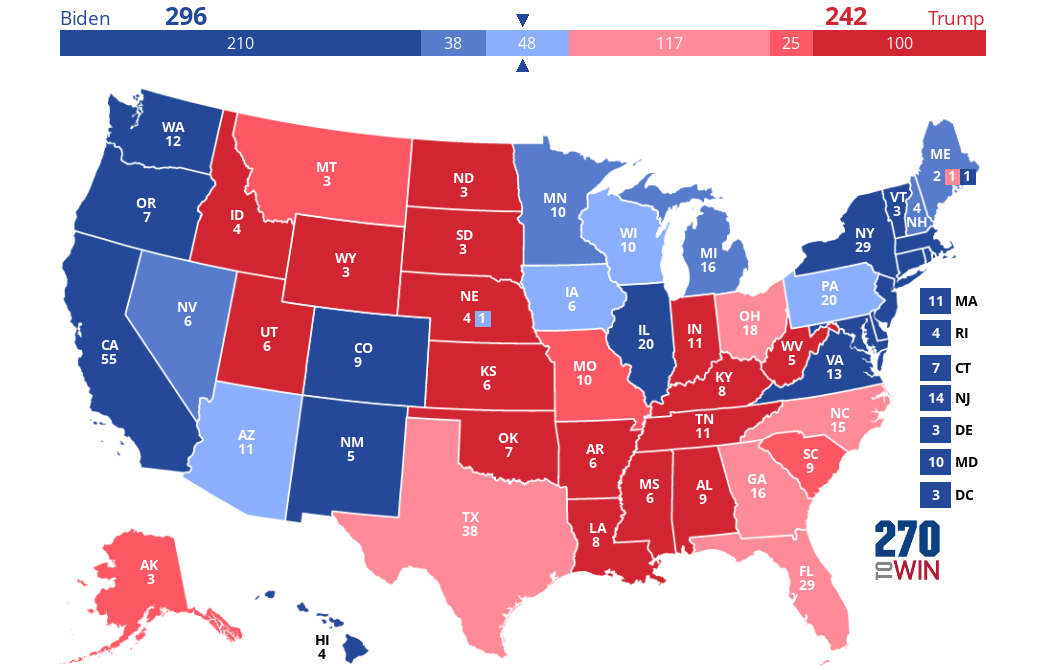
Finally, the Electoral Vote count (prior to shenanigans):  Biden 296, Trump 242.
Trump loses despite several important successes in holding FL, NC, OH, GA, TX, and ME-2.
Biden wins the Clinton states plus AZ, WI, MI, PA, plus IA and NE-2.  

Winning Iowa--it may be very close and take awhile, even if they report quickly, and may not be at all critical to the Electoral College outcome--would be a great cap to a historic comeback for Biden and his unification of Democratic political forces.  His disappointing fifth place in the primary almost killed his candidacy, but that was just the Iowa caucus craziness we all love.  All the candidates came around fully to support him, and that's one big difference from 2016 this time.  

Dedicated to Jenifer Kelderman Stoner (a fan of 5). 


Click the map to create your own at 270toWin.com

Notes on  Five Ways...: 
 *There are lots of other possible changes, such as Trump winning Nevada, New Hampshire, or Biden winning a state like Montana or South Carolina, but, like Iowa, the ones with less than ten electoral votes generally won't make a difference, singly. There are some permutations where Biden winning Iowa could make the difference, but they are hard to concoct (one is the combination of NC and IA, which makes 21 EV together, the same as WI or MN and AZ).  

 **The Nightmare Scenario, my own Personal Conspiracy Theory is Biden winning, 270-248, or leading, 269-249, and waiting for PA. 

 The possibility PA could be challenged later could make for a very nervous time, reminiscent of the election stolen from Samuel J. Tilden for Rutherford B. Hayes in 1876.+ 

 In the case when Biden has only 270 clear votes, any faithless elector (or other kind of slip-up) could be fatal for our domestic tranquility, and the second--any scenario, in fact, where Biden has 269 uncontested Electoral Votes--could lead to the Constitution's absurd "one state, one vote" House process, almost certain to be won by Trump.

+ https://en.wikipedia.org/wiki/1876_United_States_presidential_election
  

Wednesday, April 01, 2020

5X5: #1--Since We Been Gone

Thinking about The New Life

A comment line I had today with another at the site of Political Wire, an ongoing, lively discussion of the latest political news.
(mi5scents)Likely changes from this--1. a greater re-evaluation of having so much manufacturing in China--including medical items and pharmaceuticals, 2. a greater willingness to accept tighter border controls and 3. a greater appreciate among many of the importance of a strong public health system and those who work in it. In Europe, Italians are likely to long remember the EU's response to their request for help, and not in a good way. Bottom line--it isn't likely to advance globalism.
  • Avatar


     Upvote for your thought piece, and I agree with 1. and 3. As for 2., though, border controls don't mean shite to a virus. I'm serious.
    Here's my shot: Big changes to airlines, which will have to change their Coach seating patterns (thankfully so, though it will cost us more), and to food production/consumption, which will become more local. Cruise lines will downsize their ships or disappear, with those monstrous boats re-purposed for something. Many people will fear to join in large gatherings for a long time, which will have some subtle effects (another blow to the rock music industry--rent those boats for "cruises to nowhere"?).

    What I'm praying for is that global capitalism will be replaced by global community as civilization's guiding force.
As a retired statistician, there's a lot I could bore you with regarding my study of the curves, but I will summarize and say that the second derivative of the number of new cases is a good leading indicator for the key statistic, which is the change over time (first derivative) of the net number of cases (active minus cured). 

The number of deaths follows from that, subject to adjustment for the quality of life-saving healthcare and the comprehensiveness of testing.  Based on that, and my assessment of the quality of the US' response to date, I estimated a few days ago that the number of deaths due to the coronavirus in the US for 2020 will be 80,000.  I'd call that a "good job" for Trump--a 3 on a scale of 5.   Or on a scale of 20,000 to 5 million.  So, yeah, a lot at stake.

One piece of good news (for me):  New Mexico seems to lead the nation in tests per capita to date, and our Governor Michelle Lujan Grisham is suddenly emerging as a potential VP nominee for Joe Biden.  I endorse the idea wholeheartedly; in fact she is my first choice, given that Pete Buttigieg seems to be out of the running.  She has stayed well ahead of the curve in terms of her communication and the clarity of her executive orders.

Trump's administration defines the curve, for better or worse. Mitch's point that it (Trump/Mitch/Congress/whatever) got distracted by the meteoric news cycle of the impeachment and critical Democratic primaries has some merit*.  That is no kind of excuse, though, not for an individual, and certainly not for a Federal government.  That is kind of the problem, though--the effort has been 'federated" way too much.  Granted, I wouldn't want Trump making life-and-death decisions for others, given his ethics, but this is a real good example of how bad states' rights thinking is in critical, national policy-making.

That is no criticism of the governors themselves.  As I have already suggested, there have been true standouts.  If this pandemic had just hit the US so hard a month sooner, we'd probably be seeing Draft Andrew Cuomo sweeping Super Tuesday (in the guise of "Undecided")--once again, for better or worse.  If we were a tree, we'd be looking pretty thin at the top, though our trunk be solid.


I aim to follow up with four more posts this week on possible divertissements, notwithstanding.


*I have elaborated somewhat to improve his argument, which failed miserably.  Hope remains alive to eliminate directly all possibility of Mitch pulling off a Netanyahu.

Friday, February 08, 2019

Yearbook Photos and Quotes

I remember the quote I put on my picture for the high-school yearbook:
I had a good quote to put in, but I forgot it. 
I wasn't actually being truthful with that quote: I had thought about it and decided that was what I wanted to put in, and further, I liked the way it suggested that my answer was spur of the moment.

What's the point?  A conscientious person is careful about what he says in public.  Even in that pre-Facebook era (early '70's), we knew, or should have known, by the time we finished high school.

To some extent, responsibility for publishing filthy yearbook material should devolve on the institution:  Eastern Virginia Medical School, who was in charge back then!?  Unless, of course, a yearbook is published entirely independently of the school by some local printer, which I think would be the exception.  The conclusion you must unavoidably draw is that these school institutions tolerated expressions of racial supremacy, while they would not have tolerated, say, nudity.

Knowledge of that should have conditioned the editors of the yearbook, and in the case of Governor Northam of Virginia, I would think it is critical to consult them as to whether "Ralph"* had been expected to provide, or to consent, to the stuff on his page.

In this sense, I think the best possible move in Northam's case was to announce his resignation effective in 30 days, giving the issue time to be fully understood.  It may turn out that way, anyway; he might end up resigning, and it could be just as well.  The same goes for Lt. Gov. Fairfax, who may or may not survive but deserves the opportunity to remain and defend himself if he so chooses.  If Northam is to resign, he should have the chance to control the succession.

One thing was clear in the 2017 election:  Virginia voters chose against racial attacks (see the campaign of Ed Gillespie, the Republican loser).  If the only reason Northam wants to stay on is to have the discussion regarding the deep-seated enablement of racism in Virginia's culture, that's worth ten full one-term gubernatorial administrations in "the Commonwealth".

Back to My Favorite Subject
I went to Jr. high and high school in Virginia, in the beautiful Shenandoah Valley.  We wouldn't have put that kind of stuff in our yearbook, nor would we have it on our stages.  Why?  Because we had black people in our schools.  That's strictly-white-people stuff; the stuff some would do or say if they knew there were no blacks around,  such as in a segregated school or a private school.

Which is not to say there were no racial tensions where I was--there were plenty. Mostly they were below the surface, though a single incident could lead to big problems.+

So, there were a few people I knew who loved to make racial slurs.  Learned behavior, I'm guessing.  They sought to be careful, though, not to be overheard.  The rest of us, we didn't have to join in, agree or anything--just nudge them if they needed to shut up.  That's what I'm talking about when I say the problem--and I'm fairly sure it hasn't changed all that much--is the "enablement of racism".

I didn't get it for quite awhile afterwards.  It is the notion that it is not just a question of the safety of such talk, or of free speech; it is the need to challenge it.   What seems strange is that it isn't "on behalf of my'uns", but of course, that's just what it is!

 I don't know about Northam's area--he is from the Eastern Shore, I've heard, which is a place unto itself--and, as I say, this medical school's yearbook thing is quite suspicious (as are the folks' motivations for turning this up just now), but he gets the chance to say what his experience was growing up, how people treated him, and how he responded.   Then, preferably, he resigns and goes back to his life in peace. 


*His real name is Ralph?  Seriously?  (I always think of the actor Jeremy Northam, who could easily have portrayed the 'guvnor in the film biopic of this guy's tragedy.)

+We had about 20% blacks in our schools, typical of the area (Shenandoah Valley had less slaveholders than much of the South). Today, that population mix means "fervently Republican", for some strange reason.

Saturday, February 24, 2018

My Monthly Rant: A Plug (Unpaid) and a "Tweet"

This is from a group that calls itself "The Resistance" in its email communications. This  headshot picture of Trump seems to shown him in hellish flames (also very Wizard of Oz).  That is what "inflammatory" is all about.  I am not endorsing all this site's policies--although I agree with a boycott of direct Trump Co. companies and some of their enablers--I recognize that a boycott that is too broad is impractical.  But I do like their way with words. 


Join the Resistance
Dear 
How long will it be before Trump tries to arm fetuses?  Only for self-defense, of course.
In the wake of the mass shooting at Douglas High School in Parkland, Florida, the Lyin’ King thinks he has a solution.  Guns for teachers. 
Well, at least he didn’t suggest bazookas for boys.  Or grenades for girls.
Would someone please explain to the Short-Fingered Vulgarian that crossfire is unlikely to end the problem of assault-weapon attacks in schools? 


Would someone please explain to the Talking Yam that his “brilliant” idea would fall victim to the simplest possible countermeasure?  The countermeasure called shoot the teacher first?
Just how dumb is this latest Trump-twaddle?
You could make a better argument for universal Facetiming to class.
You could make a better argument for mandatory bullet-proof vests for all students.
You could make a better argument for refusing school admission to anyone unless he or she is naked.  (Go try to conceal an AK-47 when you’re nude.)
And here is the ultimate better argument: Donald Trump should not be President of the United States.
Please contribute to $10, $25, $50 or whatever you can spare to the most important issue in America today: how to save us from the ignorance, asininity, imbecility, obtuseness, brainlessness, recklessness and outright idiocy of Donald J. Trump >>

http://www.lockhimupnow.org/trump_lies


And, for the RNC: 

a reply I liked (second-hand) for their request on Twitter for comments and suggestions: 


1) Stop the corruption within your administration.
2) Sign the sanctions against Russia
3) Stop taking blood money from the NRA and sign common sense gun legislation
4) You broke our healthcare-fix it
5) Clean Dreamer Bill
6) Stop tweeting like a crazy loon