Translate

Saturday, October 31, 2020

5-D Preview of Election Night and the Hereafter

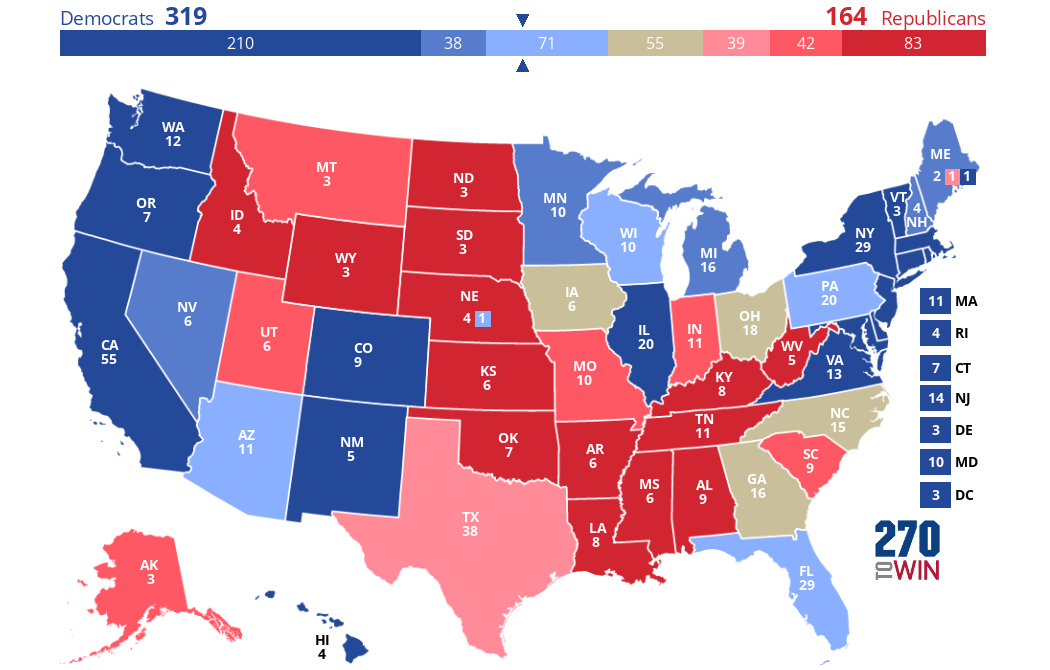
The focus on Pennsylvania in the Presidential contest has become intense, with both campaigns going all-out to win it above and beyond all others. It is justified, though, when you consider the math of electoral votes. For either side to win in the various scenarios which arise directly from recent national election results, Pennsylvania's 20 electoral votes are crucial

 There's a problem for us election result consumers, though; if Pennsylvania is close, it won't be called for days, due to a number of pending absentee ballots which may or may not show up after Election Day and may or may not be challenged. And it looks as though it will be late on the count of the mail-in ballots received by Election Day, anyway. 

 So,

                             * * * * * 

Five Ways Biden Can Win Before PA is Called (Viewed as One Play in the Game of Craps)

1) Come Out with a 7. (Florida)
The ideal outcome for a short play. It is only mathematically possible for Trump to win without it, not realistically so. Most likely outcome for FL is very, very close, though it still may be called Election Night, one way or the other. Just don't expect it to Come this way.

2) Roll an 11. (Arizona) 
AZ is very much a necessity for Trump, just as Florida is. 
There is really only one minor exception from it being mandatory for a Trump victory (see below), unless Trump can pick up two of the Blue Wall states (PA, MI, WI, and MN).  The dice will just have to roll around until a bit later in the night for the trend in AZ to show up, and once again, it may not be possible to call a winner. Biden was clearly ahead a couple of weeks ago, but it's tightened. 

 3) Get the Point (4,5,6,8,9,10) - (North Carolina)
 Always dicey to rely upon, but could hit. Real hard for Biden to lose if he wins there; it will tend to make up for any shortfalls. Looks to be extremely close, judging by the polls. 

 4) "Doin' It The Hard Way" - 
There are a bundle of other states in which Biden could effectively clinch a win Election Night, despite not clearly winning any of the above. Georgia, Ohio, Texas are all possibilities and should count quickly. Iowa's status is similar, though probably slower to count and less likely to matter.* 

 5) Sweating It While Having to Wait for PA - This is the one we want to avoid. Think of it as a long, drawn-out play of several rolls, with side bets eating away from the final result, whether or not we win or lose the play. It could be a win, but not the kind of satisfactory result that will make Trump go away. 

 In this scenario, Biden doesn't win NC or FL, or any of those others, but doesn't Crap Out (rolling a 2, 3, or 12, or in other words, lose WI, MN, or MI), and is ahead, but not decisively so, in Pennsylvania itself. In that case, we wait--either with or without Arizona**--for PA to produce final, unofficial results. Which they are now promising by Friday. 

Just to remind, but if the Democrats Crap Out and lose WI, MN,or MI, all may be lost while waiting for PA.  So we play with that risk accepted. 

                         * * * * * 
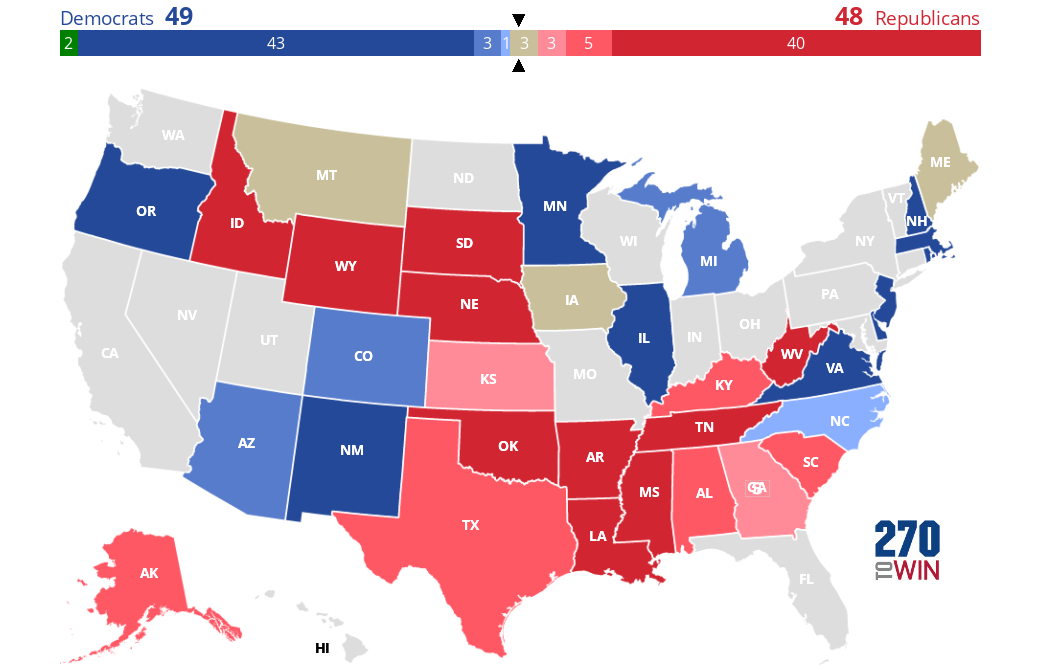
 The outcome of the Senate is as critical as that of the White House, and there's more reason to doubt it. Considering that, this view integrates the most important states for both races.  

The Five States to Watch Election Night 
(Besides Florida, of course) 

1) North Carolina - is the only critical Presidential battleground state that also has a closely-contested Senate race.  NC will report fairly quickly, though one shouldn't be surprised if there are charges of voting irregularities (coming from either side).
  
2) Iowa - has an even closer Senate race, perhaps the most critical test for control of that chamber. Though this Republican-leaning state is polling dead even between Trump and Biden, with just six electoral votes it is not as critical to the outcome.  Iowa officials claim to have their counting act together, different from the debacle in the Democratic primary. 
 
3) Arizona - If you're still up, it will either confirm the eventual Biden win late Tuesday night or throw things back into doubt.  Mark Kelly would seem to be a prohibitive favorite in the special election for McCain's old seat, but if he doesn't win Democrats' dreams of Senate control go up in smoke. 

4) Georgia - An unprecedented opportunity for the Democrats in the state: Three chances for a major statewide win, something they haven't had for decades.  Biden could surprise, but he might also be able to bring in enough turnout to make a difference in one or both Senate races.  Jon Ossoff flat-out defeating the incumbent David Perdue is no longer a shocking idea; while Raphael Warnock seems likely to show a substantial lead in the general election 'jungle primary' for the special election of the other Senate seat, though without getting a majority.  Both races would go to a runoff in January if there is no candidate getting an absolute majority, which, if the control of the Senate is still in doubt, would attract unprecedented levels of national attention and spending. 

5) Michigan - It may be early a.m. Wednesday, but when Michigan comes out with projectable results statewide, it will be worth watching.  In the Presidential race, analysts will be looking at the margin so far vs. the number of absentee ballots not yet counted and make a probabilistic calculation of whether the outcome is determined.  If and when it is called for Biden, it will narrow the possible paths to a couple--or only one.  Meanwhile, Gary Peters' Senate race is a critical piece in the Democrats' plans to regain control--he is likely to win, but Democrats' control is unlikely to be clear unless his victory is. 
 

                         * * * * * 
Five Secondary and Downballot Stories 

A Surprise Senate Outcome --There are so many possibilities that the odds favor that there will be one.  Alaska, South Carolina, Montana, Kansas--each of those is a real, though outlandish, possible Democratic win to pick up a seat.  On the other hand, trouble for the Democratic incumbent in Michigan or Minnesota would cause Democrats great anxiety about their chances to win the Senate back.  Beyond that, there are also longshot chances for an upset in Mississippi, Kentucky, Texas or even Alabama itself, with Democrat Doug Jones repeating the kind of upset win he had in 2018.  
 
State Legislature Battles  -  The 2020 Census, itself a chess piece in this year's election, will set the stage for allocation of the number of House of Representatives by state.  Most states' legislatures have critical, highly-politicized roles in designing the boundaries of those seats.  We're also seeing how important is control of the legislatures by the governor's party.  Key battles include PA, TX, FL, NC, and AZ. 
              
Montana - There are battles at every level down the ballot, though the Presidential race is not particularly close.   The big one is the contest for a vital Senate seat held by Republican Steve Daines, challenged by current two-term Governor Steve Bullock, who's battled uphill to reach parity in the polls. The state's single Congressional seat (it's likely to pick up another after 2020-based redistricting) is even closer.  There is also a competitive Governor's race and for control of the state's legislature.  And....

Ballot Measures - Direct Democracy is on the march, with a variety of measures.  Montana is voting on marijuana legalization (as are Arizona and Massachusetts), which may boost Democratic turnout there and help their chances in those races mentioned above.  There's a whole host of measures to increase democracy itself,  including open primaries and ranked-choice voting in Alaska and Massachusetts, and measures in some states to try to de-politicize Congressional and state legislature redistricting after 2020.  Most of these will win; a majority of Americans are reacting to the current 'tyranny of the minority' and want change to it.  I am not generally a fan of States' Rights arguments, but I have to admit that some states are taking the lead where our elected Federal officeholders have not yet dared to stray. 

NE-2 and ME-2 - Two states, Nebraska and Maine, have eschewed winner-take-all for their Electoral Votes and separately award them by Congressional district (with two going to the statewide winner).  Most states have chosen not to dilute their voting power this way, but because each of these two have one very competitive district (the one in and around Omaha in Nebraska, and the rural northern part of the state of Maine), both have been visited in the campaign by the candidates.  NE-2 is seen as strongly leaning Democratic, while the Maine district leans Republican, both radically different from the state as a whole.  Note also that the Congressional races in these two districts differ from the Presidential ones:  the Nebraska district has a Republican incumbent in a tight challenge, while the Maine district has a popular Democratic incumbent expected to be re-elected. 

                     * * * * *  
The People's House 
Despite what Trump may say, continued Democratic control of the House of Representatives is not seriously in doubt.  Look for certain close House races to indicate trends emerging that are counter to statewide trends.

NM-2 --My state's downstate district tends Republican but has a Democratic incumbent, Xochitl Torres Small.  It's a large district bordering on Texas, Arizona and Mexico, and is a test of strength for Republican efforts to win back seats. 

CO-3 Another such test in this region, from the opposite side, is the race in Colorado's Third district, where a gun-toting, bar-owning Trumpist woman is defending a Republican seat vacated by its incumbent. 

Texas Takeovers-- In general, I expect the usual "Close, but no Cigar" from Texas with statewide Democratic candidates (including Biden) to top off at 46-48%, as usual, but there is movement shaking at the ground level.  All of TX-21 through TX-25 are interesting battles showing the emerging Democratic strength beyond the major city centers.   This is one state where Democrats expect to gain multiple seats. 

Iowa - All four of IA-1 through IA-4 are closely contested races, including a couple that the Democrats picked up in 2018 they need to defend, and in the 4th district, a contest to replace disgraced right-wing extremist Steve King (who lost in the Republican primary).  If the Republicans are going to make a move in House seats, they need to make a mark here. 

New York (24th and 11th Districts) - The metro New York area dominates statewide elections, but outside that area, moderates have usually won election.  They are being challenged both from the right and the left.  The 24th district includes the city of Syracuse and its suburbs; Republican John Katko is challenged again by Dana Balter, and moderate Democrat Max Rose in Republican-leaning Staten Island faces a difficult challenge from Nicole Malliotakis. 

                     * * * * * 
Five Predictions 
Over-Unders  (median of my distributions):   National Turnout (Presidential election) - 156 million; 
                         Popular Vote  -- Biden 52.5,  Trump 45.2, others 2.3%
 
When will the Election be Called  (Fox and CNN) -- Primetime Nov. 4 

Rust Belt Strategy over Sun Belt (This Time)  -- AZ the only Sun Belt win for Biden; IA to Biden.  Several Southern states (GA, NC, FL) all go narrowly to Trump (<2%), TX and OH a bit more, but Biden wins all of the Upper Midwest states he lost in 2016.  

Democrats to 51 Senate seats -- There are many close races, and it will take awhile to settle, longer than the Presidential race.  It may even go to the runoff in Georgia, let's hope not.  The arithmetic works like this: 
--First, subtract Doug Jones' Alabama seat, very likely to be lost (D 46). 
--Democrats will win 3 of the 4 races in which they are leading in the polls (in order of certainty, CO, AZ, ME, and NC), losing one of them (D 49); 
--one out of two states where the odds are roughly 50-50 for a Democratic pickup (IA and GA, both seats)
--and one out of all the others.  It could even be two of them. 

Finally, the Electoral Vote count (prior to shenanigans):  Biden 296, Trump 242.
Trump loses despite several important successes in holding FL, NC, OH, GA, TX, and ME-2.
Biden wins the Clinton states plus AZ, WI, MI, PA, plus IA and NE-2.  

Winning Iowa--it may be very close and take awhile, even if they report quickly, and may not be at all critical to the Electoral College outcome--would be a great cap to a historic comeback for Biden and his unification of Democratic political forces.  His disappointing fifth place in the primary almost killed his candidacy, but that was just the Iowa caucus craziness we all love.  All the candidates came around fully to support him, and that's one big difference from 2016 this time.  

Dedicated to Jenifer Kelderman Stoner (a fan of 5). 
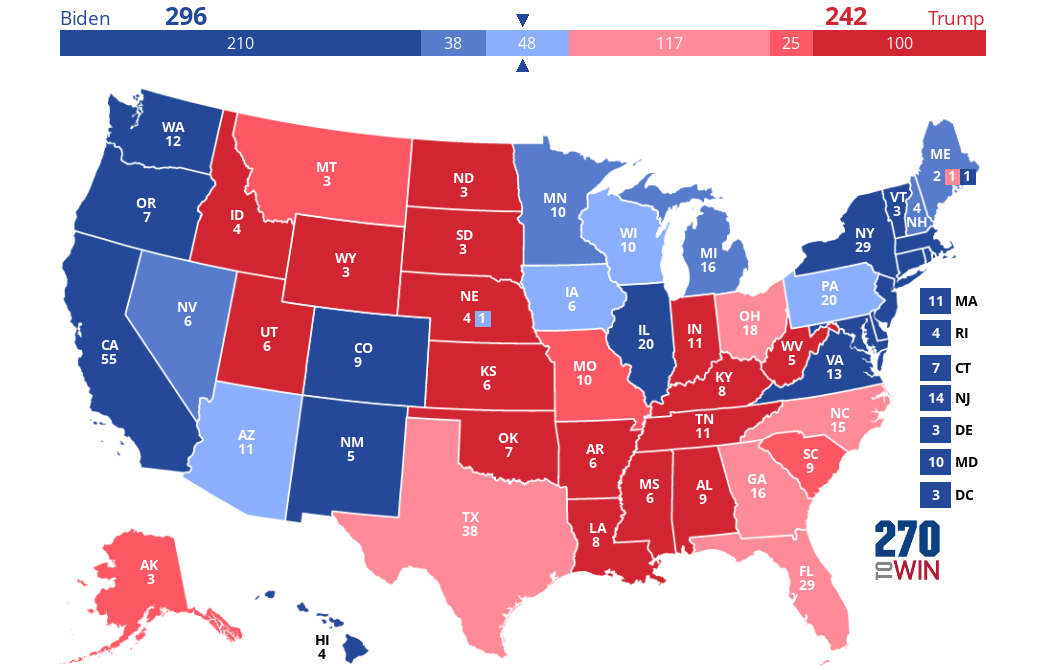


Click the map to create your own at 270toWin.com

Notes on  Five Ways...: 
 *There are lots of other possible changes, such as Trump winning Nevada, New Hampshire, or Biden winning a state like Montana or South Carolina, but, like Iowa, the ones with less than ten electoral votes generally won't make a difference, singly. There are some permutations where Biden winning Iowa could make the difference, but they are hard to concoct (one is the combination of NC and IA, which makes 21 EV together, the same as WI or MN and AZ).  

 **The Nightmare Scenario, my own Personal Conspiracy Theory is Biden winning, 270-248, or leading, 269-249, and waiting for PA. 

 The possibility PA could be challenged later could make for a very nervous time, reminiscent of the election stolen from Samuel J. Tilden for Rutherford B. Hayes in 1876.+ 

 In the case when Biden has only 270 clear votes, any faithless elector (or other kind of slip-up) could be fatal for our domestic tranquility, and the second--any scenario, in fact, where Biden has 269 uncontested Electoral Votes--could lead to the Constitution's absurd "one state, one vote" House process, almost certain to be won by Trump.

+ https://en.wikipedia.org/wiki/1876_United_States_presidential_election
  

Monday, September 21, 2020

When Heroes Fall

The lives of Supreme Court Justice Ruth Bader Ginsburg and Congressman John Lewis together show a very big truth about this country: There are many ways that one can make a difference in the great cause of "liberty and justice for all". Their examples suggest that the way can--or must--be a nonviolent one. 

  The Notorious RBG Justice Ginsburg had great abilities which allowed her, a true product of merit, to rise above her obvious disadvantages. In my view, her superpower was rhetoric, the ability to express herself precisely, concisely, and accurately, in order to persuade. Listen to her public speech: Every word deliberately chosen. 

 I leave it to others to flesh out her amazing biography, but I feel her writing will be studied as one of our greatest jurists (though too often in dissent). 

 She was very clever in the way she interacted with others, with humor and grace, and I feel she tolerated the worshipful praise she received because it did so much to encourage others. 

 It is sad that she was unable to complete this year on the Supreme Court's bench, which she loved and upon which she reflected so much honor. If only her last wish, to hold off on seating her replacement until after January 20, could be honored (see below). 

 John Lewis - The Modern-Day Social Justice Warrior? 
 You could say so, but it is a different kind of war. A nonviolent war.  Like Ginsburg, he worked within the framework of lawful challenge to legal injustice. 

 A friend of mine made the comment, referring to my condemnation of Republican hypocrisy with regard to the Supreme Court nomination, "Calling politicians hypocrites is like calling prostitutes whores." To which, my response was simply, "John Lewis?"

 I have not always been either fully aware or fully appreciative of all that he has done. I knew that he had led the Student Nonviolent Coordinating Committee when that was an accurate description of that organization's activity. I remember being shocked when he defeated Julian Bond in a party primary runoff for the Congressional seat that he then held for 34 years. Then there was a long time that we came to learn what John Lewis was about, what he had always been all about. 

And, to the greatest extent, what Ruth Bader Ginsburg's life and career were all about. Their 'brand', if you will, was about as solid as there was. Will there be those who can rise to that level, with the quality and purity of agency? At least they have opened doors. 

Ruth Bader Ginsburg - The post-mortem 
No morals, no principles. Just an unrestrained grab for power and money. 

There is a compromise, and it's not hard to find. 

 Trump has every right to nominate the candidate of his choice, but there is to be no final cloture allowed on the motion to confirm the nomination before the election. Thus the election can be conducted with the question of the acceptability of his nomination implicit in the verdicts of the voters, and the vetting of the candidate can go forward in good faith. If Trump and the Republican Senate should lose, they could go forward with the vote during the lame duck session, but at their own peril, knowing that the gloves would come off in terms of future Senate rules. 

Ideally, the new Congress can consider the qualifications of the candidate after being sworn in. Or not. All that is required is that McConnell agree not to close off the filibuster before Election Day. 

McConnell knows all this, but will give away nothing unless he must. 

He will attempt a hard line on starting immediately with the confirmation as soon as the person is named. There will be "concern" from several Republican Senators and within their ranks, maybe a thin group of binding No votes on a summary process (like the impeachment trial was). Sen. Collins can be relied upon to oppose an immediate vote, and so can Sen. Murkowski. Romney is more than just a possible roadblock.  
The fourth known potential defector (four are needed) is one who's specifically excluded a vote during election time in the past. South Carolina Senator Lindsay 'Gollum' Graham, in the electoral fight of his life, will choose the slimiest route toward the sea on this troublesome vote. His self-serving logic I believe looks like this: if he sticks with Trump on this one, he may or may not win his re-election, but if Trump wins and Graham loses, he could still maybe get a Cabinet post, specifically Secretary of Defense, a job which would certainly open up in that case. So the odds are better that way (in his calculation) than for sticking to the principle to which he invited all to hold him accountable. What that translates into in Graham's behavior will be a call for proceeding "with normal order" (as if an upcoming election does not always disrupt normal business) and then extravagantly praising the nominee and calling for approval by acclamation. 

This won't hurt McConnell in his contested re-election campaign, which for him is just about bringing home his state's base of support. It may hurt his chances of holding onto Senate control, though. Putting incumbents in tough races (IA, CO, AZ, and especially NC as examples) into a bind may backfire. My reading of his public statements does not commit him to a vote before the election, only before the end of the year. I will look for him to prepare the way (all the hearings and meetings that can be arranged), but actually hold the meaningful votes in the weeks immediately following the election, whatever the outcome. 

For Mitch, whether Donald Trump wins or not is irrelevant: Like he is for Putin, Drumpf is McConnell's useful idiot he can do without if necessary. But the SCOTUS seat for McConnell is of paramount importance. That, and somehow preventing the Democrats from reversing his weight on the scales of justice after he and his crew depart, as they must soon.

Post P-M:
  I should've posted the above last night (Sunday the 20th) but for some technical issue with the new interface on blogspot.   I watched the touching Mitch speech to commemorate RBG, followed immediately by his line in the sand.  I still see the confirmation vote being sometime in the range of Nov. 14-21, whether the election outcome is Yea, Nay, or still being counted.   That is about the best they can do, except appeal to hypothetical Republican consciences. 

I don't see this changing the Presidential race much; I do see this impacting some Senate races, and raising the level of awareness of its importance.  Unlike some others, I think this "principled stand" Sen. Collins is taking might help her save her seat.  

Thursday, September 10, 2020

Policy Proposal for Joe

VP Biden should announce that he will propose a National Institute for Home Health Work.  

In doing so, he will allow us to address a critical future need of our society and develop the value of a widespread, under-trained and under-paid service. 

Why Home Health Work?  - It is a demographic fact that the numbers of retired people, at all levels of health, are increasing dramatically, and we should expect those to continue.  

The coronavirus epidemic in the US and other countries has shown us that concentrations of people with compromised health conditions can be explosively dangerous in the case of contagious disease.  Many or most retirees would prefer to live at home, if the right care can be provided to them. 

The quality of service provided by home healthcare providers is, in general, not good enough.  In the employment marketplace today, that work is understood to be underpaid and unstable, with its main advantage being easy entry,  great demand, and easy exit.  A few manage to land private placements with more stability, but most wash out or give up. 

That is not the kind of care that people need.  There is an identifiable range of necessary skills, from first aid, medication assistance, and making good judgement calls on emergency assistance, to practical things like assisting around the house, cooking, and helping with transportation for clients.  A nationally-recognized certification and training program would assist agencies in finding qualified employees, who would legitimately expect to be paid better than today's norm. 

How? and Where? -  Most of the training needs to be done remotely, through a thin network of accredited centers which primarily recruit and coordinate, providing technical communications assistance as needed, as well.

The rollout should look like this: 

  • Bring in a small group of experienced workers, public health and safety experts, and trainers from top-rated agencies and video training experts to develop curriculum. 
  • Recruit initial groups from among top-rated home health workers to 'train the trainers'. Ensure maximum diversity.  These trainers are the permanent employees of the institute and would create a new professional corps.
  • Fine-tune the balance of "lectures", "interactive discussions", and "hands-on monitored sessions", adjusting over time with feedback from trainers.  Provide secondary assistance in a variety of foreign languages, and create an additional language certification for workers able to assist in them. 
  • Testing of learners should similarly engage online, written, and hands-on demonstrations.  The goal is to provide valid credentials and guide learners to additional training where necessary before going or returning to the field. 

The location of the Institute should be in South Florida.  That's where the greatest numbers of both clients and potential learners reside.  Other centers should be in similar magnet areas where there is unmet demand for high-quality home health workers. 

I would make a rough estimate that the whole process to initiate and roll out the program would cost $500 million.  After that, the annual cost of the service should be no more than one-tenth that; clearly the service should charge a fee, but it should be one that recognizes the public value being created, and the length of the course--some 3-6 months for workers with previous experience, a year for those without--will make it cost-effective for tens of thousands. 


Someone who has access please pass this on to the Biden-Harris campaign!  


Wednesday, September 09, 2020

He Did the Kenosha Kid

Why Wisconsin? 

There are many possible paths for the Electoral College vote.  Some, like a Biden collapse, a Trump resignation, or a huge Democratic wave, are real but relatively unlikely.  If most of the states fall out in accordance with historical patterns and continuing recent trends, some number like the low 200's can be expected to fall out to each side.   This excludes surprise scenarios like Biden winning TX, GA, OH, or IA, and Trump winning states like NH, NV, NM, and, importantly, MI.  It has been reliably reported that the Trump campaign has pulled its TV ad buys there, and polls publicly reported are showing Biden's lead now just above the margin of error.  

So, the starting point for this main scenario is a 238-203 Democratic lead.  

Here's the visual image: Endgame scenario - pt. 1

The ones not assigned are the remaining "battleground states"--FL, PA, AZ, WI, NC, and (newly-added to the list) MN; also two single-vote congressional districts in the two states that divide their votes up that way:  the Second Congressional district of Maine and of Nebraska (ME-2 and NE-2).  Remarkably, both are expected to be close. 

Florida and Pennsylvania are two states both campaigns have at the top of their priorities:  if Biden can win both, in this high-likelihood scenario he has the win; if Trump gets both, with North Carolina Trump is at the verge.  Let's divide them, though, according to the preponderance of recent elections--FL and NC to Trump and PA to Biden.  

This brings it to the grim endgame scenario, Biden up to 258-247.  (Here's a link to see that scenario:   Grim endgame) In order to win, Trump needs two of the remaining states (MN, WI, or AZ), and one or two of the single-vote districts. (Or all three, of course).  Biden needs one of them, with one or two of the secondary targets.   

This is why Trump had to go to Kenosha.  The national Trump campaign is working the "Law'N Order tactic", and the purpose was not to console Jason Blake, paralyzed by multiple shots in the back, but to stir up more resentment among those who felt their security endangered by the uprisings against police violence. This was targeting the suburbs of WI, MN (shaken by the George Floyd killing and its aftermath), and all-important PA.  

As for AZ, I have heard that Trump has pulled ads there, and Biden continues to show small leads in this state, which is trending Democratic after a long, uninterrupted string of Republican Presidential wins there.  I predict the Republicans will try to regroup around a law 'n' order themed attack, especially if there is some kind of domestic strife in Phoenix's Maricopa County.   Finally, a tell that this endgame strategy is fully in play will be special effort in those two Congressional districts (ones Obama won that went narrowly to Trump in 2016), the Omaha area of Nebraska and rural upstate Maine. 

So far, though, there is little evidence the George Wallace-ite approach has moved voters enough in those  key states.  For this, I can give some credit to the much-discredited discernment of the electorate.   

Tuesday, September 01, 2020

Boiling Over

 If that new managed account is doing reasonably well, I'd look to move some additional money to it from the big Discover savings account (which is now paying only about 1% interest).  In the meantime, it can wait a few weeks.  Third quarter earnings reports in October will be watched unusually closely. 

* * * * 

Oh, sorry, wrong Clipboard.  

Here is a response I wrote on dailykos just now in response to an article citing Trevor Noah's " quote:

Enough with this "militia" bullshit. This isn't the Battle of Yorktown. It's a bunch of dudes threatening people with guns. 

“Dudes threatening people with guns” is bad enough; it leads to armed, violent encounters.  Like Kenosha, but worse.  

On the other hand ‘dudes with guns who threaten people’ is worse. 

We must expect that, in the leading nation of the day, in this technologized era,  ‘people’ are presumably unarmed.  Threatening unarmed people with even ‘unloaded’ weapons is a crime!  Unfortunately, in this nation at this time, we cannot assume that. There is one flaw: Can you find it? 

* * * * 

I've seen a lot of discussion and points being asserted with regard to two recent national polls showing a six-percent margin, as opposed to the nine-point ones in recent weeks.  The press release from Yahoo! was typical, highlighting this alleged trend, instead of this more interesting bit:  

The new Yahoo News-YouGov poll shows that nearly every voter in America has made up his or her mind, with 96 percent Biden and Trump supporters now saying they have decided how they will vote — up 2 percent from when the same voters were surveyed in late July. Only 8 percent remain undecided"

Despite the faulty math, the fact remains that there is only a small percentage of leaners to be decided in the debates and campaign shows.  The real game is about getting those votes in and counted. 


Response to bhatman

Oh, yeah.  Simple choice:  It's the Biden-Harris ticket, or shitting oneself on the toilet, once again.  No other choice. At some point, the flush is going to give out.  


Chinese and Russian tyrannies are looking for signs of decrepitude in our republic they can exploit.  Japan is going to be a surprise watchpoint in foreign affairs.   Meanwhile, our lawlessness is showing, once again.   Brazil is always the country of the future.  With luck, we could be Brazil soon.  

Ever see the movie 'Brazil'?  Great satire, one I usually forget to mention when making lists of my very favorite genre. 

* * * * 
One of Fareed Zakaria's best shows ever last week.  How the rest of the world sees us.  (Available on podcast.)  I find that our fellow humans are being somewhat patient, maybe seeing the end better than we; the fires of war abroad are smoldering, rather than burning, and they would prefer to have our "leadership" when the crunches come.  Translation:  regime change, please!

Edit--added 9/9/20: 
Comment (9/3) on a Haaretz article, titled "Netanyahu May Be Just as Corrupt and Disruptive, but He’s No Match for Trump in Terms of Crazy", by Chemi Shalev: 

who is the better con man, Bibi or Drumpf? Netanyahu's con deserves respect for its long run and complexity, but Donald trumps him with its world-historical audacity.
Can he succeed in the end, get away clean? His US holdings may be forfeit in the end, but the outfit can probably continue on thru JaredCo. As for exile, he's trying to swing Istanbul. In preference to a dacha in Yalta. I'm thinking Ankara.


Saturday, July 04, 2020

Pure (Prairie) Politics League--Short-Term Considerations

(In honor of the new PPP, the Paycheck Protection Program, a good bit of improvisation.)

I was an ActBlue junkie
I love ActBlue, and there is much to say in favor of it:   it is one of the Democratic party's most effective weapons, greatly facilitating impulse contributions from its sympathizers.  Contributors feel, correctly, that someone is listening.   Analysis of which responses elicit the donate reflex is sophisticated, subtle, multi-dimensional. If one believes that electoral competition is a dynamic synthesis of ideas, then the algorithms used will help make it so, in the interest of maximizing power (money).

My intention in 2019 was to encourage good arguments, causes I support, and electoral  participation.  My usual answer to an appeal I like was to give them the very small number they initially ask for, like to a mendicant ($3 is that most frequent ask amount), but if not, I give $20.20,  Then I like to see whether they have record of the previous amount(s) the next time(s).  Sometimes they do, sometimes they don't.  Sanders' database managers are one of the best, from this angle.

The bad news is the lack of strategic consideration in this impulse buying.  My objective in 2020 giving must be to assist specific electoral outcomes.  My budget for direct contributions is $1000--I have to stick to it, for hygienic reasons.  10 months to November, $100 each month, ideally two donation recipients, $50 each.  Sorry, that's it, though "in kind" contributions are certainly being considered. Progress report below.

The vice I have traded this one (reading 20-200 emails a day asking for money, and spending money on the ones I like) for is active monitoring of my predictit.org hobby account.  It's cheap entertainment:  I have put in a total of $200 over five years, and I make lots of small bets, small comments on the site, and adjust constantly.  I will refer to it some below.


Four More Months
Four months ago, Joe Biden had just turned it around in South Carolina and was preparing to wipe out the competition on Super Tuesday, the endorsements suddenly flooding in.  The economy had not yet collapsed due to virus spread.  President Trump's favorability was nearing a record high after surviving the impeachment trial; polls showed a small Biden lead but the incumbent was generally favored.

That's how quickly things have changed, so they could change again.

It is possible to construct an electoral scenario in which Trump keeps self-destructing all the way through the election.  The popular vote margin, now polling at 10 points, could keep expanding, to 15-20 points.  The Electoral College vote for Biden could break 400 votes, a margin of over 250; Texas would be the tipping point for a real blowout, even bigger than Obama's win over McCain. It has happened before, though not yet in this century.

It's a hopeful thought, though it can only happen if this series of unfortunate events deepens.  It could happen; there are a variety of unpleasant October surprises no doubt lurking due to past Trump offenses, like the one that happened in late-June instead this week (with the revelation of bounty payments offered by the Russian GRU to Afghanis to kill our soldiers), with Trump once again looking to be the Mad King no one dares to cross.

I think it much more likely that the race will tighten.  Just as Democrats who didn't care for Biden have had to come to terms and back the guy chosen as champion for their side, many Republicans or Republican-leaning independents would love to come back to Trump if he earns back the confidence he has shaken in these months.  The economy will certainly show some improvement from its trough in the second quarter.  We should expect Trump's approval number to rise from the high-30's to the usual 42-43%.

The other change I expect is the effect due to the changes between registered voters and actual voters.  I don't see an enthusiasm gap at all, but I see a lot of potential obstacles, in many states, which will have disproportionate effects.  Voter suppression efforts, combined with disruptive coronavirus effects, could erode the Democrats' turnout more than their opponents'.

Here's a map of where sentiment lies now, backed by Predictit bettors' money, on the individual state markets (and Congressional district ones, where applicable), for the 2020 Presidential election:
https://www.270towin.com/maps/7D9YO


Click the map to create your own at 270toWin.com
Key:  Tossup--margin between Republican vs. Democrat in the market is 15% or less, either way; Lean - margin is 16-45%; Like is 46-75%; Safe is 76%or more. 


The Senate Map
(Same approach.  Keep this one in mind, too--it's just as important as how big Biden's win must be.)


Click the map to create your own at 270toWin.com


If I (Joe Biden Campaign/DNC) had $200 million to invest right now (and they do), I (they) would see that the challenge is that the US is such a "target-rich environment" (as Donald Rumsfeld might say). This is how I'd spend it, by state: 

A. Primary Targets

Pennsylvania/Michigan--$25 million each.  Joe Biden must win these to justify his nomination, which basically rests on the assertion that his candidacy has the best chance to win back these two states, and their 36 Electoral College votes, that went narrowly to Trump and were critical to his victory.  If one looks at the map above, with MI (just moved to "Likely" over "Lean" in Predictit) and adding PA to the Solid and Likely sum, Biden gets to 268 electoral votes.  If he secures these, he needs only two more, from somewhere.

Florida - $40 million.   The state has surely frustrated in the past, but Democrats can win it--Obama did it twice. Trump, with the assistance of acolyte Governor Rick De Santis, has given Biden a golden opportunity, and some additional seniors have been persuadable about Trump's incontestable incompetence.  If Biden wins FL, it's pretty much OVER--it could even make up for inexplicably losing MI or PA (but not both).  Florida's population resembles the US' as a whole in many ways (though a few points more Republican), so the popular vote shift in Biden's favor (vs. HRC's in '16) should translate well in FL.

Arizona/Wisconsin - $15 million each.  These are the best opportunities for additional electoral votes, after PI, MI, and FL.  Biden needs only one of the two, and Arizona (like FL, a Covid-19 disaster area with a GOP Governor mishandling the pandemic) is very promising from all indications, also a huge Senate seat prospect.  WI will be a war, but it must be engaged, again.

B. Secondary Prospects
Georgia, North Carolina, Iowa, Texas - $7 million each.   These are the opportunities to make Biden's win truly historic.  They rise to the top of the many possibly blue-ing states because of the chances to win a Senate seat downballot.  GA has two seats that can be won, a rare opportunity that could be squandered without full support, while Iowa (the worst Biden state in the primaries) is now looking possible for both Biden and Senate candidate Theresa Greenfield to win.  North Carolina has 15 winnable EV and a winnable Senate seat, too, with a fair election.  (GA and NC money should go in large part for pollwatchers and lawyers).  Texas has the same opportunities--less likely, but even more transcendent in their potential historical impact.

C. The Rest 43 other states/entities - $1 million each.  This includes DC and Puerto Rico (in support of Carmen Yulin's run for governor there).  Bonus $1 million grants:  MT, ME, SC, AL, for their important Senate races;  MN, NH to defend competitive '16 Clinton states;  OH, just because; and Nebraska and Maine (again), $1 million extra for special effort in each of the two states' 2nd Congressional district.  In the bad-case scenario of 268 Democratic Electoral Votes described above, the door out of that room is winning those two marginal districts in states which have their electoral votes divided up by district.


"Slow Down on Testing"
No, he doesn't "kid"--though he's still one emotionally. He lies. With measurable and predictable frequency.

Rather, he makes stuff up--it just comes to him, usually from the Ego, but sometimes from the Id.  He doesn't filter it, not often, but just "says what he thinks".  The key for him is what he sees as the result of his trial effort.  If it seems to work for him (by his standards), it becomes part of his repertoire.  If the reaction doesn't please him, it's discarded.

This process is something that Donald Trump is incapable of understanding, lest it change "the way he thinks", which is the one thing that is all-important to him.  He could never be capable of explaining it coherently (or even 'covfefely'). So, when he got challenged on it, he came back with the "strong" response, which his conscious mind might have realized was the wrong answer, an idiotic one.

The latest indignity is the news that the E.U. is banning Americans, along with some other countries that are experiencing higher coronavirus infection rates than any of the European ones these days. This is to be a temporary measure, but I find it rather astounding nevertheless.  It is an administrative nightmare, to which penning Americans with the relatively-smaller number of other foreign travelers (not from East Asia) simply adds.   It would be a wonderful gift to the U.K., which is busy failing with Brexit and needs a boost badly (try London City Airport to avoid Heathrow), but the U.K. is theoretically still in the E.U. for this purpose--it will be interesting to see if the Brits follow F. Mac's advice and "go their own way" on this one. It would, of course, devastate many potential travelers' plans and give another mortal blow to airlines.

Europe, in theory, is justified in protecting itself, apart from any political consideration.  The US has reopened before it had the initial outbreak under control.  That is a fact. The answer is a testing regime for travelers, including post-arrival quarantine of 7 days, and evidence of a return ticket paid for.  For Trump, though, this is an embarrassment he richly deserved, and it may explain why he might plead for less tests, in his ignorant view.  The fact is that the E.U.'s evaluation required nations to show positive results, in terms of tests taken and low infection rates more proven.

Rolling Some Numbers
We have now blown out the projection I made of 80,000 Cv deaths in the US in the initial wave.  The way I was looking at it then, it should've trended, about July 1, toward zero, as many European countries have now done--something like the 110,000 number it busted through recently.  But now, it is accelerating once again and is projected, in Dr. Murray's new-and-improved forecasts, to reach some 190,000 by October.

It is arguable that what we are experiencing is the rolling continuation of the first wave as it hit more-densely populated areas less intimately connected to the initial sites of domestic infection, and less protected from rapid spread.  Because one thing we have learned of this virus is its great ability to spread, its R-nought.  It was initially estimated between 2 and 3 and projected based on that, but now I am hearing numbers over 5 among unprotected populations.  At that level, it's gonna spread, and eventually will overcome all but the strictest limits.  But these more remote areas now having the highest infection rates might have been protected if we had a plan to do so.

Happy birthday, Concept of the United States of America!

Wednesday, May 20, 2020

5X5: #5- The New Life

This is the fifth and final of the series of thoughts from the coronavirus quarantine, looking within, outward, and ahead.  Instead of five in five days, or even five weeks, we've had plenty of time to make the fisstu' and let it simmer. 

Food
We've been fortunate with regard to access to quality local options to get food, and no excessive restrictions.  I want to give my greatest praise for the modern supermarket, especially the ultramodern one, which was ready for the logistical challenge. There were those who went crazy with the overstocking of certain items, but that was corrected before long.  The idea that toilet paper would be something to hoard--even with the supply chain inertia around the industrial/commercial rolls--is an example of a kind of craziness that has been the exception rather than the rule.  

I consider the past few years to have been the Golden Age of Global Food.  The downside is its cost; not all could access it.  One reads of the feasts of the kings of the Middle Ages, or in classic Roman times; this kind of plentiful variety is accessible to a much broader population today, but will it continue?  I have my doubts.  Though we can still insist on quality--or not, as many will opt--the quantity and variety of food ingredients and products may decrease. Instead, I expect less fresh produce brought in by airplane from exotic climes, and less fresh meat from distant factory farms.  

Meanwhile, I've been putting in a lot more time developing my cooking skills.  We now have the time, the material, and the information needed to try new dishes, though most of my designs for them start with the basic ingredients of olive oil, onion, and garlic, and going from there.  I have drifted a little into Thai, Korean, and Chinese methods, but I have to restrain myself with regard to the chiles and such. 

I have also started a diet for the self-quarantine period.   My 'Covid-19 Diet' has the objective of losing 19 pounds; I'm a little more than halfway there.  The concept is the mini-fast; by eating nothing for more than half the day (at least 12 hours, preferably 14-16), the body burns off pounds gradually.  I do it roughly the opposite of the Muslim Ramadan approach:  my last food should be around sunset, then I have nothing (except water, and coffee--black, no sugar--in the morning) until around 10-11 a.m.  I then eat freely during the remaining daylight hours.  I've always been a brunch fan--now I can have a brunch-like meal seven days a week, the daily schedule allows it (no alcohol, though). 

Buildings
Shelter--the right kind, in the right place--has never been more important in modern life.  Thus, those who do not have "all the comforts" are especially at a disadvantage for their mental well-being, though we see very little of that in the televised reporting from these elite individuals' personal home offices.  Peloton has never seemed more appealing, though they seem to have pulled back on their ads--cash flow crisis?--in favor of ubiquitous adds for insurance of all kinds and pharmaceuticals. 

Still, I feel quite certain that humanity will have little trouble adapting to Coronavirus Rules, even if they are with us for decades. I am reminded of a science fiction story I read once but can't place:  was it Asimov, or Arthur C. Clarke, maybe?  It posits a distant future where people rarely, if ever, meet up in person.  Instead, their holograms meet up in a safe place.  The quality of that very possible future lifestyle will depend on a lot more development of what we refer to today as virtual reality.  VR is more of a gimmick than something with convincing verisimilitude and the full range of sensory input today, but give it time:  Artificial intelligence used to be a sore disappointment, almost an oxymoron, but no one is laughing at the idea of AI today. 

The problem with people's lives being limited to being physically at home all the time is what is sometimes referred to as "nature deprivation".  Even during this crisis, it has been critically important, for mental and physical health, to get out and get some sunlight and some exercise in a natural setting.  In that regard, I am very sympathetic to those in the big cities with the stay-at-home orders and feel that the trade-off required has been (net) harmful to many, while being relatively safe here+, and still able to go out--working in the yard, taking hikes or bike rides--has been a comfort. 


The Eponymous Novel (Orhan Pamuk, 1997)
I'd had this paperback in the house for some years, didn't know where it came from, but when I ran across it in my little bookcase for potential reads or partially-read ones, I figured this is the time.  Orhan Pamuk is the Turkish novelist awarded the Nobel Prize for Literature in 2007; this novel was first published in 1994, one of his earlier efforts, and translated into English in 1997.

The opening grabbed me.  Its first sentence:  "I read a book one day and my whole life was changed."  Yes, I could identify. A young male student sees a book carried by a beautiful woman colleague, tracks it down, and reads it obsessively, day and night, and can think of nothing else. The book offers the promise of a new life, and in that life everything that was before, though it remains still, is somehow different when framed by this. 

We come to realize that the ideas of the book will be shown only through the course of our young man's impetuous adventures.  In 1990's Turkey, this takes the form of going, on buses operated by a variety of private bus lines, to the most obscure areas in the country's vast interior.  Searching for that woman, with or without that equally mysterious man seen with her, who may well be other atoms, following the same kind of random movement patterns.  We're not sure, though, as our guy saw her companion, Mehmet, shot and then disappear from sight. This wandering goes on, with great Pamukian embellishment, for fifty pages or so. 

Then Boom!  The inevitable head-on crash of buses,* and somehow our protagonist and the object of affection are literally thrown near to each other.  Operating Platonically (i.e., no sex, despite himself), they begin working together to try to decode and translate into practical action the precepts of the book, which leads them to a conspiracy-theorist, known as "Dr. Fine".   They infiltrate his family presenting themselves as a promising young couple ready to be mentored.   They eventually take off, separately, pursuing their destinies.  

It's a somewhat trying book to digest, because it teases much more than it delivers.  About halfway through, I resorted to reading some reviews to see what I was missing.  The answer was: not too much, at that point.  I learned that the name of this book he read and obsessed about will not be disclosed, nor much of its contents.  Some reviewers were respectful (no less than D.M. Thomas wrote the review for the New York Times), some reduced it to a shaggy-dog story.  To that, though, I would disagree; there is definitely a resolution, and a lot more opportunity to fill in the dots than that would suggest.    

(the following bit has spoilers)

 The key to the plot comes early, from the mysterious initial companion of our heroine, Mehmet (not his real name), when he says, "The way of the book leads only to death".   The conflicts in the course of the novel involve the fundamental Turkish challenge,  melding all of Western European/American civilization with the ancient traditions of Western Asia.   In the resolution of its mysteries, the course of the novel narrows its range from a yearning that is universal, for greatness and the sublime, to desires that are intensely personal and surprisingly mundane, even antisocial.   In this regard, the novel brings to mind the work of Umberto Eco, or very differently, Albert Camus.  Characters in the story make their choices, often inexplicably, unfeelingly, or on false impressions, but randomness rules.

It may be needless to say, but The New Life  hasn't changed my life much yet.  The novel was very popular in Turkey, with a lot of speculation about its hidden meanings:  Was it about the Koran, or some other religious text, or about the Gulenist cult (which was allied with Erdogan back then, seeking a modern religious revival in the country, and in conflict with the repressions of the secular authority)?  Well, not exactly--that unnamed book's proposed lifestyle was something more like the old American TV series "Then Came Bronson", if you remember it:  a drifter, his identity and purpose shown through heroic acts as he travels from town to town.  One amateur reviewer of Pamuk's novel titled his effort as "Blood on the Tracks", referring of course to the Dylan album, the tracks being here the dangerous byways of Turkey.  A very good summary phrase to which we Westerners can relate.


*One aspect mentioned several times was that it seemed to our main character that the mysterious book had been written as though it were specifically for him.  For me, that resonated with the bus-crash motif.  We had taken a long drive through the Turkish countryside in our honeymoon trip in 1993, and there were several near-miss head-ons or ravine plunges, due to narrow roads, blind curves, no shoulder on the roads, and trucks and buses driving pell-mell.  So, I could identify with that, too.

+23 cases so far in Taos County; no deaths. 

Monday, May 04, 2020

5X5: #4--Entertainment! for a Time of Sickness

The added free time can present some annoyance, if not properly filled.  There have been any number of posts and articles with ranked lists, offbeat suggestions, rumors of new (usually filmed at home) shows and performances.   I've been scanning through them and have a few of my own, mostly through experience of the otherwise dreck and re-runs .

'Contagion' (2011) as Intro Course for Dealing with The Real Thing
If you have not seen this Steven Soderbergh movie this year, you could've had a crash course in this year's pandemic in two hours.   (OK, one hour 46 minutes, according to imdb)  Early on in my confinement, I managed to find it for another viewing.

It's painful, but also a story of survival at the level of the human experience through the whole course of an emerging pandemic, with a superb cast and script.  Much will seem familiar, because it's what we're going through. It's a different virus, with a different trajectory, but so much of it could have prepared our society for it, if we'd watched it and taken it more to heart.

The basic parameters are an outbreak of a "chimeric" virus (bat/pig) spreading easily by respiratory means from an initial set of infections in China and carried on by international air travelers.The US breakout  (Minneapolis) is shown through the tribulations of the husband (Matt Damon) of Patient Zero (Gwyneth Paltrow), and his daugher (their young son succumbs early).   Then, she has a sudden, fatal seizure, and it goes from there. The infection begins to spread through casual contacts she made en route back home from her business trip to China.

(Some of the next bit may be spoilers...)

 Among aspects that the careful attention to science+ captured for the film is the rapid deciphering of the DNA of the virus, but the difficulty in developing a vaccine for a novel virus.  The CDC official on the scene of the breakout (tragically awesome Kate Winslet) opens a hospital triage location in the largest stadium in the city.  Her boss (Laurence Fishburne) is shattered and cuts some corners, but he ends up being heroic. There is a blogger (Jude Law) who peddles a false remedy, and various story permutations follow for him.  The film explains the "R-nought" concept, the number indicating the propensity of a disease to spread--it's actually just the average number of new cases per existing one.++

The movie posits panicked runs on supplies (in the film, on pharmacies), with those leading to some looting (including guns) and rioting. There are even armed security screens at state boundaries mobbed with cars.  So far, to Americans' credit, the social response in our reality has been more restrained, the recent Astroturfed protests in a few states notwithstanding, at least partially because the mortality rate of the virus in the film is several times higher than our (much-disputed) own.  Rather than anarchy, in the real world the poor seek healthcare.

The film also has an international element, addressing the problem of the worldwide distribution of the eventual game-changer, the vaccine.  A WHO official (Marion Cotillard) is kidnapped by provincial Chinese seeking to jump the queue.  One of my few criticisms of the film's resolution is that the global challenge is presented early in the cycle but not closed.  The lottery-type distribution of vaccine issuance by birthdate that the US decides upon (the hand of partisan politics is barely felt in Contagion) brings domestic peace, but what about....(insert names of many failed nations)?

Somewhat on this topic, I have found reference to a sci-fi novel about a breakout pandemic and authoritarian measures taken to contain it, written in 1997 with the prescient title 2020 (by Hamutal Shabtai).  From the interview with the author, who is somewhat apologetic about the length of the book (I haven't tackled trying to find it yet),  the story includes the aspect of China trying to suppress word of the burgeoning threat, the challenges of systematic testing and how it erodes free society, and then the potential brutality of policies separating those detected as infected from the vulnerable.


+Ref. podcast interview with the film's writers for Vanity Fair,  a pro screenwriter with a top epidemiologist.  Quality, Soderbergh style.  The podcast may have a paywall. 
++Here is a set of estimates of the "R-sub T", the infectiousness of Covid-19 over time by state, made a couple of weeks ago.

Saved by Infection?
Back on the topic of movies and invasive species, the other must-see for this period of time, if you have not seen it, is the film that may signal the eventual redemption of the Oscars, which seemed lately to have fallen into a permanent trap around Hollywood's immobile conventions and their lack of diverse creators, roles, and economic opportunity.  I was so appalled by the nominations this year I hadn't even written my usual Oscar preview here, and I watched most of the show with a resigned lack of enthusiasm.

That changed for me when they announced the winner of the Best Director award, and I gave a shout of joy when Parasite won Best Picture.  It showed me that the Academy's voting electorate, within the straitjacket of the nominations, had brought the right attitude.  One way to make Oscars more interesting is to feature more prominently the excellent films produced around the world, with the aim of making the show truly a world championship (since a competition, it seems, it must be) and not a high-priced back-pat.

I am totally committed to the experience of cinema, like theater both public and private, of the darkened room and the big screen, but Parasite, though plenty visual, will stream very well, or indeed work with any format.  What makes it special is its manic creative energy, astonishing characters, and intricately-woven plot.  The one downside for me (slight spoiler) is the Tarantinesque "cathartic" bloodbath near the end, but it is redeemed with a Hitchcockian post-climax twist.


TV Overview:  Delving into the Escapist Void
Enough education, though.  Let's talk about entertainment which takes us away from virus-related concerns.

My tv-watching habits (mostly sports, news, science/nature shows, talking-head public affairs) have taken a serious and sudden change.  No more live sports, and the news is always pretty much the same.  The talkshows haven't taken much of a hit, and nature photography is better than ever before.  (I particularly liked the PBS' Nature show for Easter, "Remarkable Rabbits".)   Under the circumstances, though, I've had to dig deeper.

In this depressing Drumpfist era,  I had already found it easier to glom onto iconic popular culture events that have no basis in reality.  I accept that it's a miserable excuse, and that effective activism would be a far more potent and honorable response, but these have been miserable times, and, while activism was certainly possible, its effectiveness has been blunted.

(This was due to the fog created by Chief Twit Dimwit's lies and provocations, McTurtle's slow walk to 2020, and endless blather from those seeking some kind of lawful justice that Robert Mueller and his report,  House committee subpoenas, and Senatorial Profiles in Cowardice can never provide.  Seeking satisfaction was self-delusion, a sort of escapism. *)

And so I chose to attend the two singular popular culture events of 2019:  The Avengers: Endgame and the final season of Game of Thrones.   The first got much greater praise than it deserves, while the second has been criticized more than it deserved.

Serial moviewatching is a venerable tradition, and comic-book hero movies are similarly well-established. I have not gone so far as to immerse myself in their multiverse, though.   I read comic books sometimes way back when, but I didn't really care if they were DC or Marvel, even then.  Save for a few SH movies I've seen over the years--I was somewhat impressed when the Christopher Reeve Superman series combined the commercial potential of the '60's Batman series with somewhat less cheese, and I enjoyed Robert Downey Jr.'s rehab work as IronMan, and Alfred Molina any old time (Doc Ock!)--little stands out  (OK, I'll admit that Guardians of the Galaxy was funny.)

Because of this limited emotional commitment, my appreciation of the biggest movie box office film of all time was stunted, particularly so as I have never seen Part I of the Avengers megahit two-parter.  It made for a fairly objective viewing of what I came to see as a standard-issue time-travel script.  Star Trek did it at least as well, from the point of creative storytelling. Doctor Who does it with more humor and better aliens.  Obviously, the production values of the Marvel series are world-class, but that is just table stakes for action megahits:  we want more!**

As for GoT, one has to credit the patience and depth with which this fictional world was developed.  I will admit it was a lot more data than I was willing to take on.  I had seen an episode or two, casually, over the first years of its run, so I knew the stars of the story and some of the place names and story themes.  I watched all of the penultimate season, binge-watched seasons 1 and 2 in the marathons prior to the release of the final season (but then stopped due to some travel), and then the ultimate one.  So, I saw the half I wanted, retained some significant holes in my understanding of past events, but had no problem following the fast-moving final season.

I was not one of those sorely disappointed by the outcome.  The key aspects of the two-part wrap (the war with the Walkers, and the siege of Kings Landing) did no more than bring things to ends prefigured (as possible outcomes) earlier, through the track of the main characters' destinies. The political denouement of the new king, etc. was anticlimactic, which is the norm for the end of great TV series.

Two things, related, that I really loved about it:  1)  the importance of that limitation of time and linear space which constrained everything in a pre-vehicular era, and then how dragons were the equivalent of nukes that dissolved those limits; and 2) the opening credits!  The effortlessly shifting camera angles and focus on the regional map (see below:  the big picture looks suspiciously like Greece, the Aegean,, and Asia Minor) served effectively to transport us into the fictional world.  I already see evidence that the excellent notion of that sequence has been picked up by other series.


*I barely escaped from that depression, only to fall into the crater of our disappointing Presidential primary and its excruciating, ugly process. Waste can be defined as the Cost of Bad Quality.  As the subject here is another, and we have somewhat crawled out of our crater, I will say no more.
**By "we", I mean "I".  Seems like the rest of the world had little problem with it. 

It's a Reality Show World
"This ain't really life, ain't really life, ain't nothing but a movie."--Gil-Scott Heron,  B-Movie
This was in 1981, just after we were all shocked as the reality sunk in that Americans had elected an actor, Ronald Reagan, to be their President.  You could extrapolate to the present, and then it would not be so surprising to consider our reality becoming virtual, a video game of some sort.  But, no--much more disappointing. 
"The Revolution Will Not Be Televised" - Gil-Scott Heron, again.  
Ten years ago, that quote was not viewed as being proved false--social media was enabling movement faster than the cameras could arrive.  Now, we know:  television (video) is too much a player to be revolutionary, and is an important tool in the hands of Reaction's surveillance. 

I won't say I never watch so-called Reality Shows:  As a family, we enjoyed The Amazing Race (travel being a big thing for us), and some Fear Factor (spectacularly gross, but limited variety).  I have tried to avoid any others.   Though imitation of reality is at the core of storytelling, and even documentaries generally are edited, these shows that purport to be real but are artificially created offend my sensibilities.  Amazing Race was a good example. It never broke the fourth wall, but in every one of those taxi cabs or jitneys, or airplane cabins or customs lines there was, somehow, a camera capturing all their squabbling and confusion. Come on. 

So, I have to admit that I have watched a lot of The Voice, and not just this year, because it's one of my wife's favorites.  I am continuously impressed by the quality of the performing contestants they bring to the show, and the sophisticated arrangements and staging are impressive.  I hate the show's formats for the (exaggeratedly slow) series of cuts to the contestant pool, though, and the amount of fluff that is padding the (excellent) performances is excessive.  

While there is too much emphasis on the coaches' phony "win" percentages, I also tend to feel that the real performers are somewhat exploited--though I admit, willingly so.  They are not amateurs, but semi-pros; most have honed their performing craft in a variety of live settings, but they need that big break (which I am far from convinced comes through the route of these shows--current Voice coach Kelly Clarkson is the only true star who has emerged this way, to my knowledge).   The winner should be guaranteed ample cash money plus a recording contract, and all the finale performers paid generously.  Are they?  Generally these shows would say so if it were the case.  Instead, the coaches get the big payouts, making this the Nike of game shows.  In normal times, I'd say it's good for local employment (in LA). 

With the dearth of live entertainment for The Voice to continue the final rounds of the current season, our TV has picked up a show, Songland, which followed it on the same channel in recent weeks. I have seen a couple episodes, but no more.  It is sort of the obverse of The Voice. The idea is that semi-pro songwriters come in with a potential pop song which they pitch--through performing it--to a team of songwriting coaches and a performing artist who has promised to record it (and give royalties for it to the episode's winning songwriter, and presumably, their coach).  The three finalists (out of four) for the episode then re-work the song with the coach's assistance, to fit the performers' preferences, and the performing artist chooses the winner at the end.   I believe it's the show's second season. 

As a format, it's good: much better than The Voice's one, concise, straightforward, and honest. Though the royalties for the song will likely be rather trivial in the end, there's a chance for a big payout, and at least it will give some honest credits for the resume.  The songs themselves are not really my problem, as they are all designed to provide an immediate hook, and a catchy hummable chorus.  The better ones have clever wordplay in their required rhymes.  So, we all know what is what, about this kind of song, but the making of the sausage itself is what disgusts me, even if this is like the real-life pop music "sessions"  For me, the show is simply too damn formulaic--the romance is nowhere evident. 

A couple more Small-Screen World comments for this special time of unquestioned TV cultural dominance:  This situation reminds me of the time in the early '80's when music videos suddenly became a very big deal (they already existed in limited number and quality prior to that).  The choices you as video producer had were somewhat few:  you could show the band performing the song, or pretending to perform it while doing something, or show the story the song was trying to evoke, or something completely unrelated (which was rarely greenlighted for production).  The chops for performing in a studio environment, which musical performers have have developed and perfected over the years, serve them especially well in this environment, whether they play to the camera or ignore it.   

Still, whatever your content, you can either present yourself in your office--there may at least be the shelves of books you may have read behind your shoulder for the viewers to enjoy--or in your garden or backyard, or present a series of other people doing the same.  I guess a couple have tried for a more intimate setting, though I have seen only one on a roof, and none in a basement.  But that's limiting, for sure.  Here are a couple ideas if this continues to drag out: 

A quick-hit musical variety show with topical content, like Laugh-In; 
A holographic (instead of Zoom) meeting of a small group of participants; 
Performances in concert halls with minimal attendees (5% capacity?), full special effects, and added sound-absorption. 

The Quality of Merch is in Its Strains
Top five of the current season--I will attest to having consumed each in the jurisdiction in which it is produced, as prescribed by law:
Blue Dream (H-NM) - 18.0%
Armagnac (S-CO) - 19.6%
Blueberry Headband (I-NM) - 20.6%, (I-CO)- Unk.
Pineapple Trainwreck (H-CO) - 24.6%; Train Wreck (H-NM) - 19.5%/
Blue Dream (H-CO) 23.6%/Blue Maui (H-NV)-Unk.
Contrary to what this might indicate, though, I'd prefer sativa if more were available commercially.  I agree with Bill Maher that they should cut down on packaging, or at least reycle their cylinders and tubes.  And, as may seem obvious, my favorite color is blue.

The Best Thing I've Seen on Facebook lately (I have no idea of the credits):  Our Current Location within a Dystopia-based Venn Diagram


From reddit/MapPorn:

Post image


Sunday, April 19, 2020

5X5: #3--The Antithesis

Virus-related Dialectics
Trump is doing no more than fulfilling the necessity of his historical role in the global event.  It was down to him to be the leading voice* of those resisting the prescriptions of the scientific community to dampen the severity of the virus outbreak.  The "Yes, but..." of those for whom unpleasant truth is unacceptable.   He staked out his stance of reluctant cooperation with the experts' pleas for physical distance, but his posture was leaning forward and outward, against all logic, at all times.

Trump is not just playing devil's advocate, which would be appropriate, particularly if no one around him is doing it. Neither is he just trying out new lines--I think he's now into his facile blame  GHINA/WHO/'BAMA one, where I think it will stay.

Instead, he is gambling once again:  first, he gambled this viral outbreak, like previous ones, could be contained within Asia and a spot or two here or there.  He lost that one--the New York Metro area is a bit more than a spot, and there are plenty of others--but that has not stopped him from gambling again.

The arguments to do more than just remain inert, a policy currently allowing economic activity around the world to continue to sink, they speak to all of us and demand consideration.  The smart play would be to help provide the specifics--logistics, counsel, analysis, and above all, money and political cover--to allow the governors to roll out operations for the full variety of business and service activity, within that framework that Drs. Birx and Fauci outlined the other day.   Instead, he promises having stadiums full of a hundred thousand fans, "and very soon!", and imagines all will be well if he doesn't bother to have any of that preparation done.

Now, I do believe that day with large-scale crowds is going to happen someday soon, and I hope to be around to see it and more, to survive the consequences of that, but Trump is not going to be President when that happens.  So I pray.

In the meantime, he has identified his role as pushing forward for targets that are inconsistent with his team's recommendations, disregarding the risk of proceeding to open in areas that have neither proven to have survived an outbreak nor tested their populations for infection or antibodies.  He is surprisingly comfortable with his role as th`e antithesis to the Enlightenment's thesis that truth is empowering and the scientific method can discover truth. 

---

That stance differs from how Trump's governance has been antithetical to Obama's.  Whatever Obama was doing, Trump has done the opposite--it was a very easy rule to follow.  The path Trump is trying to follow with the coronavirus is more complex, as some of the time he must restrain himself, even show some nodding agreement, and some of the time jump in (such as when questions irritate him), but it all lines up with his role of the great Doubter.  Politically, the synthesis somehow resolving the contrast between Obama's "Hope and Change" (moderately progressive, globalist) thesis and Trump's reactionary "Make America Great Again" antithesis is nowhere in sight.  Biden as national candidate does no more than re-state the Obama thesis.

With Covid-19, we are searching for the synthesis, the rules of the road ahead. Unlike our political stalemate, there will be a resolution of some form, forced by us.  Our shared, pent-up desire to get out will make us do things that the public health community's shared thesis argues against.  We will be opening up, in some states and communities, without the systematic, comprehensive testing capability that they urge.

---

A few comments/predictions about how that movement will play out:

Separation of those infected from those free of coronavirus can not be sustainably maintained.  Neither group can be identified reliably enough, and that may be true even when we do have enough testing data.  Evidence is emerging that the number of people exposed is several times greater than we know, and that those people may be contagious while asymptomatic, and that they may or may not have immunity from re-infection.

Vaccination may end the prolonged crisis, once it is sufficiently rolled out (and we should not expect that will happen very quickly, once it is available), but the best hope for something like "the new lifestyle" emerging sooner than that will come when we have treatments that are proven to save lives of those seriously afflicted.   There, I see some hope:  more with antivirals than with Trump's favored malaria treatment (which is somewhat brutal on the system for anyone taking it).  If it is true that we can keep those with serious infections from worsening irrecoverably, and that most people's exposure does not result in severe illness and respiratory failure, then the risk of being with others will drop enough for activity to commence.

---

Some final observations:

I am guessing Steve 'Race' Bannon himself came up with those "Liberate __(fill in name of Dem.-governed state)"  incitement-to-riot tweets in MI, VA, and MN.   Real cold-blooded, subversive provocation with clear political intent (to challenge polling deficits in states the Republicans would like to open up for competition this fall).

I find the current, revised curves produced by IMHE and used by the government to forecast to be too optimistic, particularly with regard to forecasted trends on Covid deaths.  The projections are nice negative exponential curves, but they are too contemporaneous with the hospital usage curves (deaths will lag for weeks), and they decline too sharply for those states at, near, or beyond their peak.  Just look at the actual curves for New York, or for the hardest-hit European nations.  There is not any sharp decline, but instead a plateau lower than the peak period.   As for those states not yet peaking, the curves are very optimistic (and will have to be changed once stay-at-home orders are relaxed).

Who is 'Race' Bannon?
https://www.youtube.com/watch?v=ToQ-S1g8CJM


*Bolsonaro is another.  Boris "TheSpider" Johnson played with the notion, before failing spectacularly.  Sweden provides a different example, an alternative approach (not requiring social distancing in normal interactions) that may end up being much like the US' variety of outcomes, once we relax strict guidelines.

Re-edited 4/21.  

Sunday, April 12, 2020

5X5: #2 - Retirement vs. Physical Distancing

Over the past months some have asked me about how I find retirement. Those of us who are in the new employment category called "Stay at Home" (different from "Working from Home") are experiencing some changes in their lives--some of those are like my frequent retirement-based life, but some are radically different.

What's more-or-less the same: 
You wake up, realize you have minimal obligations, smile and roll over in bed.
Good morning, good morning!

Nobody bugs you, except on your landline if you bother to answer.  There's no business worth using the cellphone.

Still don't really need Linkedin.

Nobody writes to you in the mail, except a few who still have some lingering hope of getting money out of you. That number is steadily decreasing--is the Post office leaving junk mail to "season"?  I guess that's OK, but like many things now, not sustainable.

You have texts, email maybe (depending on the recipient), other forms of communication through compromised internet channels.

What's very different: 

Live TV:
We have gone...From National Pastime


To National Facepalm


I actually just watched the 1996 National Spelling Bee finals on ESPN, and was grateful for the chance to do so.  That's how bad it is for sports.

No money coming in to us ordinary folks--(everyone is hoarding cash, and all that Federal stuff is going to someone else ).  For example, I am owed a decent tax refund from Illinois from 2018, and I'm quite certain no one will look at my amended return anytime soon.

Every bill you pay seems like a major concession now.  Cash is king doesn't even begin to cover it adequately.

The famous "Taos hug" we all know and love has been extirpated.  Will it re-emerge in The New Life, once this change process has run its course?

Wednesday, April 01, 2020

5X5: #1--Since We Been Gone

Thinking about The New Life

A comment line I had today with another at the site of Political Wire, an ongoing, lively discussion of the latest political news.
(mi5scents)Likely changes from this--1. a greater re-evaluation of having so much manufacturing in China--including medical items and pharmaceuticals, 2. a greater willingness to accept tighter border controls and 3. a greater appreciate among many of the importance of a strong public health system and those who work in it. In Europe, Italians are likely to long remember the EU's response to their request for help, and not in a good way. Bottom line--it isn't likely to advance globalism.
  • Avatar


     Upvote for your thought piece, and I agree with 1. and 3. As for 2., though, border controls don't mean shite to a virus. I'm serious.
    Here's my shot: Big changes to airlines, which will have to change their Coach seating patterns (thankfully so, though it will cost us more), and to food production/consumption, which will become more local. Cruise lines will downsize their ships or disappear, with those monstrous boats re-purposed for something. Many people will fear to join in large gatherings for a long time, which will have some subtle effects (another blow to the rock music industry--rent those boats for "cruises to nowhere"?).

    What I'm praying for is that global capitalism will be replaced by global community as civilization's guiding force.
As a retired statistician, there's a lot I could bore you with regarding my study of the curves, but I will summarize and say that the second derivative of the number of new cases is a good leading indicator for the key statistic, which is the change over time (first derivative) of the net number of cases (active minus cured). 

The number of deaths follows from that, subject to adjustment for the quality of life-saving healthcare and the comprehensiveness of testing.  Based on that, and my assessment of the quality of the US' response to date, I estimated a few days ago that the number of deaths due to the coronavirus in the US for 2020 will be 80,000.  I'd call that a "good job" for Trump--a 3 on a scale of 5.   Or on a scale of 20,000 to 5 million.  So, yeah, a lot at stake.

One piece of good news (for me):  New Mexico seems to lead the nation in tests per capita to date, and our Governor Michelle Lujan Grisham is suddenly emerging as a potential VP nominee for Joe Biden.  I endorse the idea wholeheartedly; in fact she is my first choice, given that Pete Buttigieg seems to be out of the running.  She has stayed well ahead of the curve in terms of her communication and the clarity of her executive orders.

Trump's administration defines the curve, for better or worse. Mitch's point that it (Trump/Mitch/Congress/whatever) got distracted by the meteoric news cycle of the impeachment and critical Democratic primaries has some merit*.  That is no kind of excuse, though, not for an individual, and certainly not for a Federal government.  That is kind of the problem, though--the effort has been 'federated" way too much.  Granted, I wouldn't want Trump making life-and-death decisions for others, given his ethics, but this is a real good example of how bad states' rights thinking is in critical, national policy-making.

That is no criticism of the governors themselves.  As I have already suggested, there have been true standouts.  If this pandemic had just hit the US so hard a month sooner, we'd probably be seeing Draft Andrew Cuomo sweeping Super Tuesday (in the guise of "Undecided")--once again, for better or worse.  If we were a tree, we'd be looking pretty thin at the top, though our trunk be solid.


I aim to follow up with four more posts this week on possible divertissements, notwithstanding.


*I have elaborated somewhat to improve his argument, which failed miserably.  Hope remains alive to eliminate directly all possibility of Mitch pulling off a Netanyahu.